Meal 34: Chad

Chad spans the three S's of the heart of Africa: the Sahara desert in the north, the arid Sahel in the middle, and the wetter savanna to the south. Or put into culinary terms, this extent is why we see both dates and peanuts factor into this meal.

However, on the heels of the generically-named Central African Republic, Chad's another country that poses some online searching problems, at least in English. To wit, I was looking for advice on cooking the staple grain of that country, but a search for [chad millet] turns up a doctor with that name in Louisiana. Fortunately, French provides a nice opportunity for disambiguation: they spell it Tchad, and as far as I could tell, nobody goes by that name.

Chad's going through a rough time right now: the food crisis in the Sahel has made food scarce and expensive across much of the middle of the country, and unfortunately the World Food Program is predicting a looming humanitarian disaster. They're hoping to help 1.2 million people in Chad alone — now would be an excellent time to consider helping before the situation turns from "extreme" to "famine." Our guests' generous donations tonight, after matching, will enable WFP to provide 1,000 meals.

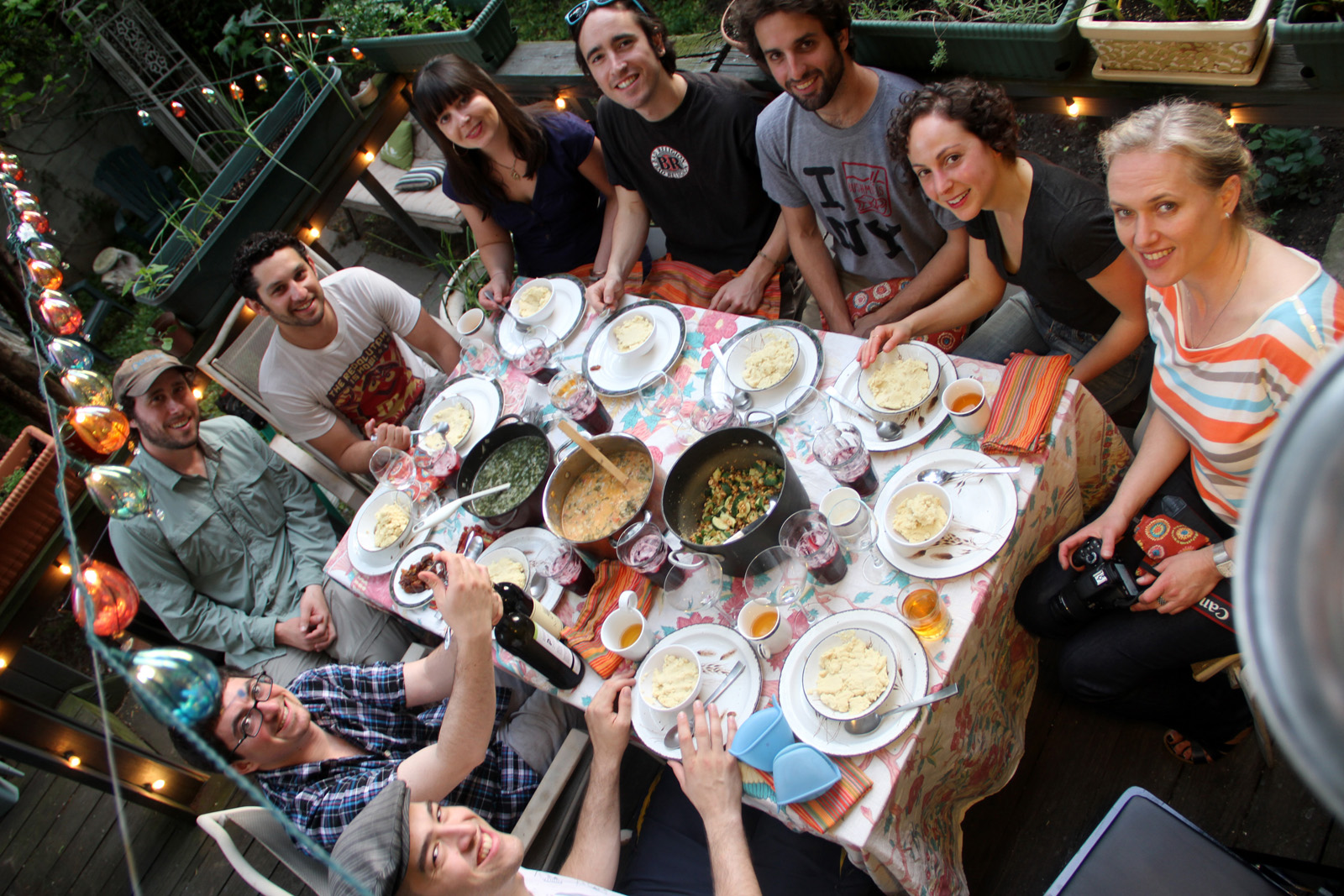
Tonight's guests included Matt Green, a nosher with a mission: to walk every single street of New York City. Check him out! We also welcomed Matt's friend Jason, Laura's psychogeography professor Rachel and classmates Alex, Grayson, and Gabi, and Bradley and Jenny. Although Chadians are relatively big meat-eaters, we kept this meal pescatarian.

Karkanji | Hibiscus drink | Recipe (translated to English)

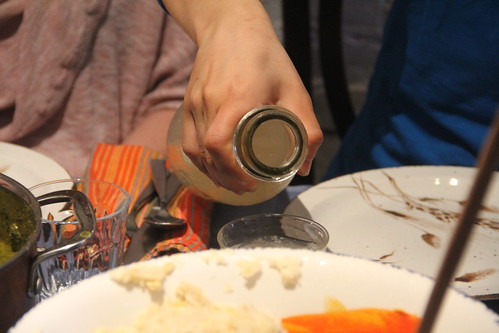
Along with the traditional Chadian welcome of sweet green tea, dates and peanuts (according to this page), we served this super-refreshing drink made of steeped hibiscus flowers (aka sorrel, or jamaica in Spanish). With ginger, cinnamon, and cloves, this tasted downright Christmassy. All the ingredients are so pungent that I made two batches from the same base of stuff, I just added more sugar and water and steeped it again.

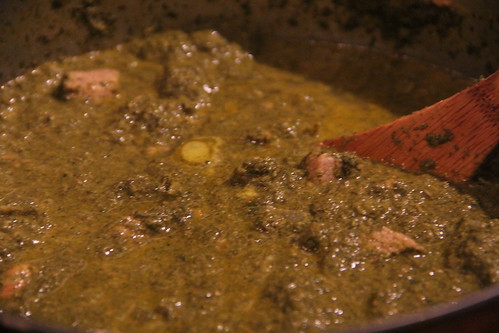
Sauce koumragan | Sorrel leaf sauce | Recipe (translated to English)

I was planning on making a dish with okra, but when I happened upon bunches of sorrel at the farmer's market, I had to let fate sway me. The full-circle nature of this is just too good: use the flowers for the drink, and the leaves for the dish! I modified the recipe to be vegetarian: I upped the onions and added tomatoes in place of meat, and used porcini bouillon cubes (hey, it's what I had on hand) in place of veal bouillon. Turned out pretty tasty!

Mulukhiya | Recipe (translated to English)

Whatever goopiness we missed from skipping okra, this one made up for in abundance. This plant is sometimes known as mallow, in fact its mucilaginous properties are what they used to lean on to make marshmallows before they discovered more convenient ways to make sugar goop together in a fluffy manner. It was kind of hard to get beyond the texture because the dish itself wasn't terribly flavorful, despite the exotic smoked fish which added surprisingly little. I know we'll encounter this vegetable again as we go through Arab lands so I hope to improve on my mallowmaking.

Courgettes avec des arachides | Squash with peanuts | Recipe

Seems so simple, with nothing more than salt to flavor it, but this mix of squash (or in this case zucchini) and peanuts is really tasty: both peanuts and summer squash are mildly sweet, and the mushy and crunchy play off each other well. If you choose to make this, note that the five-to-ten-minutes for sauteeing until soft is wildly optimistic, I budgeted 20 to 30 minutes and used it all.

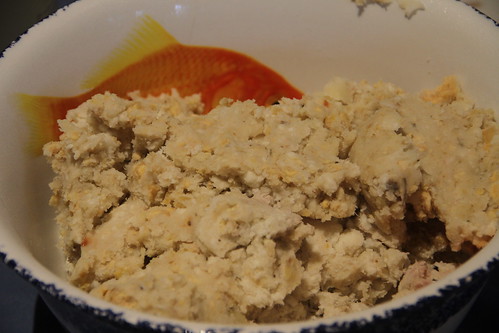
Boule | Millet ball | Recipe

Another African country, another fufu derivation! In Chad the staple grain is millet, though it was tough to find instruction on how to actually prepare it. I finally found this one that advised putting a little wheat flour in, and that probably helped it thicken up. Following instructions, we pressed the mush into lightly greased bowls and inverted them to eat from.

Jus de fruit | Fruit shakes | Recipe

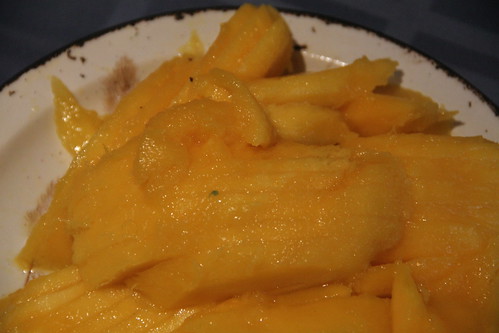
Pretty straightforward and tasty, we made them with both mango and papaya. Even better with some rum.

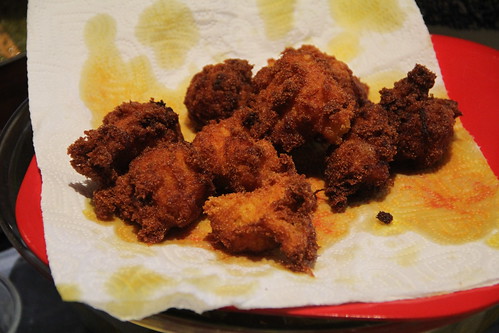
Fangasso | Fluffy beignets | Recipe

A rather common name for these crispy, airy concoctions is pets de nonne, or "nun's farts." I'd never quite made anything this way before; from the initial instruction of melting butter in water it was all an unfamiliar approach, but I'll be darned, once batter hit oil, these things puffed up and got all lovely. The one modification I made was to cook them in palm oil, hopefully it was something like you'd get on the street in N'Djamena.

And that does it for our stretch of six African countries in eight meals! We take a break next weekend, followed by a trip to the Catskills where we'll cook Chile.

All photos by Laura Hadden who, after the guests went home, accidentally ate the beignet batter thinking it was boulet.

This Saturday: Real Mongolian food and fundraiser

Our first guest post comes from a fellow traveler of the world's foodways, Charles Bibilos. Like Jesse and Laura, I’m thoroughly obsessed with international food, and write a blog called United Nations of Food, which documents my quest to eat meals from every country in the world, without leaving NYC.  I’ve eaten food from 115 countries over the past two years, but my attempt to eat genuine Mongolian food has turned into an accidental fundraising adventure.

I would love to pretend that I’m as consistently well-intentioned as the United Noshes team, but the honest truth is that I was selfishly searching for a Mongolian meal when I ran across the story of Urangoo, a 13-year-old Mongolian contortionist whose father was killed in a Mongolian mine (for a longer version of Urangoo's story, visit http://bit.ly/zCR5rq).  As soon as I read about Urangoo, I thought it would be fun to use our gluttony as a way of helping Urangoo’s family, and a few of us—including an American journalist and a Mongolian scholar—decided to host a food-friendly fundraiser at Jimmy’s No. 43 in the East Village at 1:00 on Saturday, May 12.

Since you’re reading one of NYC's finest international food blogs, you might be wondering: what the eff is Mongolian food?  It isn’t “Mongolian BBQ”—that stuff was invented by a Taiwanese marketing genius in the 1970s, and has nothing to do with Mongolia.  Real Monoglian food is far more interesting, and much milkier:  homemade Mongolian cheese (made by our Mongolian co-host), a dessert called khailmag (“caramelized clotted cream”), lamb dumplings, Mongolian meat tea (yes, you read that correctly), deep-fried Mongolian butter cookies, and… drum roll please… fermented mare’s milk!  (Full disclosure:  we’ll be serving a modified version of the mare’s milk, made from fermented cow’s milk. Sorry, we couldn’t find a milkable mare in NYC.)  We’ll also have a cooking demonstration by a renowned Mongolian dumpling-maker, a live auction of Mongolian calligraphy and leather art, and a performance by a Mongolian throat singer.

Suggested donation for the event is $35, and full details can be found at http://bit.ly/JIRQk6.  If you have questions, you’re more than welcome to email me at unitednationsoffood@gmail.com.  And even if you can’t make it to the event, send me an email if you’re interested in Mongolian food, and I’ll do my best to save a few sips of meat tea and fermented milk for you.  

Meal 33: Central African Republic

I'd have been pretty clueless about what to cook were it not for a chance introduction to the daughters of the US Ambassador to the Central African Republic. You see, I begin my research for a country's cuisine by searching online, but the Central African Republic certainly wasn't thinking of search-engine optimization when they chose their name, and it's super hard to find info that relates to the country and not to Central Africa generically. But thankfully, through my friend Oliver (sous chef for Cameroon!), I met the Wohlers daughters, and got first-hand advice on what to cook from those who know! This was really handy, because some of the food, like the mangoes and the avocado salad, aren't exactly the sort of things you find recipes for, but are the touches that make for a more representative meal.

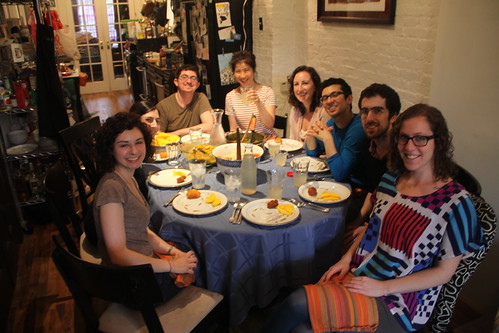
We hosted a rare Saturday brunch because Laura and I rode the Five Boro Bike Tour the next day with an early wake-up time. For whatever reason — perhaps the country name that few have heard? — we didn't get many signups off our list, and it was a great opportunity to invite some last-minute guests. On hand were Jessica, Jill, Chrys, Al, Juliet, Barrak, and Kate.

This was the first meal I made with my new African mortar and pestle. Not only does it have a fun design, but having this long-handled and heavy mortar and tall-sided and heavy-bottomed pestle is a big improvement over the wine-bottle-and-bowl method I've used for previous African meals!

Boisson au gingembre | Ginger drink | Recipe

Most authentically I should have had palm wine, but I haven't seen it in any stores I've visited yet (but I hear rumors that there's a place in Fort Greene that sells it so I'll check that out soon.) I've heard ginger drinks are popular in Central Africa and it seemed fun to try, so hey. I went big on this recipe and interpreted "three or four big pieces of ginger" as one honkin' one pound hunk that I got for just $1 in Queens. Well, that, plus pennies' worth of sugar, cinnamon, cloves and lime juice made for a gallon of deliciously sharp refreshment. A good idea to keep it in something you can shake like jars with lids, because the yummy bits settle pretty quickly. It also mixes nicely with grapefruit juice; you could get adventurous with gin!

A note on technique: I pounded the ginger in the mortar and pestle before soaking it in boiling water; you could grate it or whiz it in the food processor, but both of those methods would release more juice and might make for a different flavor. Also, I didn't do the second hour's worth of soaking in a warm spot, I just added warm water from the tap and stuck it straight in the fridge.

Mangues | Mangoes

According to our source Sophie, who's spent considerable time in CAR, during mango season the fruits are abundant and free for the taking, and people eat so much of it that they poop orange. That's a pretty strong indication that we should be eating it too! I think finally, after nearly three decades on this planet, I've got a satisfactory mango-deconstructing technique: slice parallel to the flat side of the pit on both sides, use a big spoon to scoop out the mango from each side you've sliced off, slice those into thin slivers, and then hack at the pit to remove what you can. Though if you have advice, please share, since I know we'll be eating much more of this, the world's most popular fruit.

Ngoudja | Cassava leaves with beef and peanut butter | Recipe (in translation with a few of my notes)

Yet another leaves-n-peanut stew! This recipe comes straight from an employee of the US Embassy in Bangui, and apparently this is a pretty representative dish, although the meat is probably a privilege. Cassava is an extremely common plant throughout the region, both the root and the leaves: it grows abundantly throughout the year, and between the leaves and the root it satisfies two major ingredient types. Mixed with peanut butter, it makes for an earthy, slightly bitter, and filling sauce. We also enjoyed it sprinkled with some Senegalese pepper flakes that were bigger on flavor than spice, and that I hope are a decent approximation of what might be found in CAR.

Foutou| Mashed yams and green plantains

We had this sauce on top of yams and green plantains which I boiled and mashed, again in the mortar and pestle. Perhaps doing this with cassava, either boiled from whole or made into a fufu from powder, would have been a bit more representative, but we've had that so much recently that I wanted to shake it up. In the end, though, there's only so much variety: boiled, unseasoned starch is never going to be terribly exciting, although the texture of mashed-from-whole is a lot easier to get right then boiling and mixing the powder.

Linguistic note: the term foutou is one minor vowel modification away from a notorious swear word in French. It's as if mashed potatoes were named feck or something.

Salade d'avocats | Avocado salad

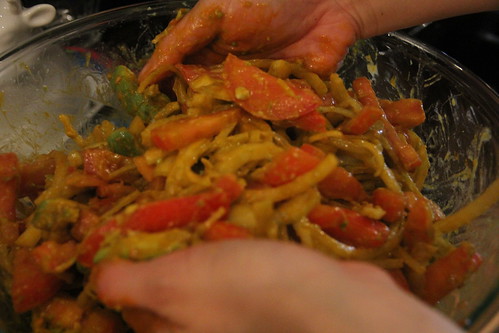
Sophie recounts that a very common salad in CAR is avocados, tomatoes, and onions, dressed with palm oil (and we added a bit of lemon juice too). Done! And tasty. I've now cooked plenty with palm oil but never eaten it raw, and wow, it lends a lot of flavor. The salad, which Barrak prepared and Chrys mixed up, was surprisingly rich and tasty.

Macara ti fôndô | Banana beignets | Recipe (translated to English)

After the Cameroon frying fiasco, I was anticipating a break, but Sophie insisted that these "beignets are sold everywhere, and people love them." Twist my arm! Out came the deep fryer, with a mix of palm and corn oils — latter to save our unaccustomed Western guts from the full onslaught of the, uh, richness of the palm oil. It took a bit of experimenting with the batter recipe. I used plantains since I figure that's what they mean by bananas in that part of the world, but either one would probably be fine. The 100 grams of semolina was not enough to absorb the liquid and made for a very goopy batter that didn't hold together when frying. With perhaps double the amount of semolina, it made for fantastic fritters: a crispy outside redolent with luscious palm oil, and a soft and sweet inside with the lovely flavor of banana and a hint of the nuttiness of semolina.


Thanks to the generosity of our guests, we were able to contribute over $160 for the World Food Program USA this week. The WFP is active in Central African Republic, with plans to serve over 320,000 people there this year.

Big thanks again to the Wohlers sisters, especially Sophie, for the help in figuring out what to cook! Next week we head one country to the north to Chad, where we'll wrap up our string of six African countries in an eight-country stretch. I'll be trying my hand at millet beer, let's see how it goes!

Meal 32: Cape Verde

Note: In 2013, the year after we cooked this meal, this country changed its official name in English to Cabo Verde.
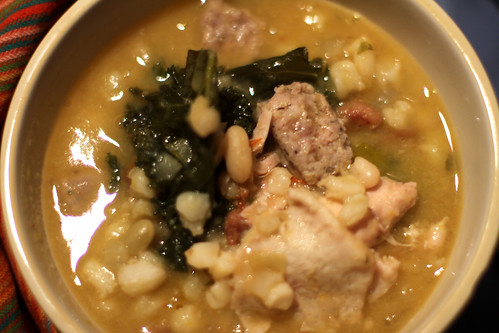
For some countries it's tough to nail down which dishes to cook, but Cape Verde, a cluster of islands off the coast of Senegal, offers an unmistakable national dish. The cachupa is a stew based on dried corn and beans, and what goes in beyond that depends on your family history, socioeconomic status, and whether the rains came.

To inventory the sorts of ingredients that typically go in a cachupa is to trace the extent of the Portuguese empire: corn, dry beans, and manioc from South America; plantains from Southeast Asia; kale, cabbage, and sausage from Europe; and yams from Africa. Conveniently enough, the Spanish colonial pantry overlaps substantially, so I was able to find just about all I needed at the strip of Mexican markets on 5th Avenue in Sunset Park. The only ingredient that I was nervous about finding was unground corn with intact germ (e.g., not nitxamalized), and although dozens of searches on Google and a visit to Brooklyn Kitchen didn't turn up anything, I found it in the Goya aisle of the local Met Foods supermarket. You know that song "Jimmy Crack Corn?" Well, this is that sort of corn.

I should also note that the U.S. is home to a long-established Cape Verdean community. Most of them are in New England, the core having made its way here on American whaling ships in the mid-19th century that often picked up crew in Cape Verde.

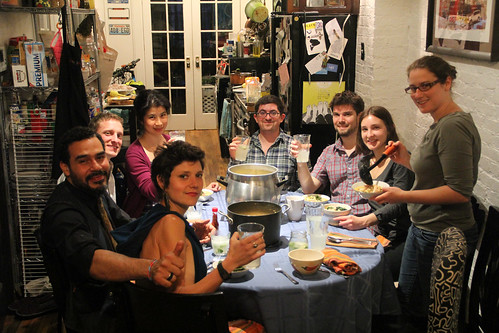
Tonight's adventuresome guests were Tammy, Raven, Dan, Chrys, Sean, Tennessee, and Lemuel, who brought lots of gorgeous Cape Verdean music — if you like the sounds of classic Brazilian crooners, you're sure to love it too.

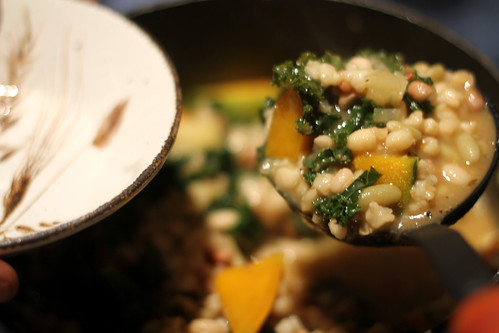
Cachupa rica | Corn, bean and meat stew | Recipe

There are many levels of cachupa-making, depending on how well-off you are and how hearty you want to eat. A cachupinha might be little more than corn, beans, and salt pork, while a cachupa rica can be a wonderland of flora and fauna, and that's what I set out to make.

There's dozens of recipes for cachupa rica on the internet, especially if you search the Portuguese web. I chose to use this one as my base, while mixing with a half-dozen other recipes I found. Here's the mods I made:

  • In the spirit of "use what you've got" that is at the core of stewmaking, I substituted the beans I had in the pantry (navy for the stone beans, flageolet for the limas, and cariocas (left over from Brazil!) for kidneys).
  • There's so little agreement on what meat to use, so I didn't take the salt pork as gospel. Instead, I used most of a chicken that I'd butchered earlier in the week at a knife skills class, and also threw in some pork spareribs, both of which I marinated the night before in various fresh herbs from the garden. I also added a fair amount of salt to the stew to compensate, but not enough since most people added more salt!
  • In addition to the tangy, red choriço, I got some linguiça (aka longaniza), a more garlicky sausage, but left out the blood sausage since some folks don't like that.
  • Instead of cabbage, I used kale, since I had a ton on hand.
  • Taking yet another cue from other recipes, I put in some chunks of peeled manioc (aka yucca or cassava) and white sweet potato.
  • The recipe doesn't specify the number of onions; for the quantity described I used about two medium onions and it turned out fine.
  • Finally, with the carcass of that butchered chicken, I made a broth, that I used in place of bouillon.
  • I also made a vegetarian version exactly like the meat-based one but, well, without the meat, with a veggie broth, and a higher proportion of veggies.
What can I say, it was a darn good stew. The corn, boiled straight from dry like recommended rather than soaked overnight, had a nice firm texture. Everything was in good balance, not too much meat or veggie, and with three kinds of beans the texture and color was pretty interesting. Also, thankfully, after so much cooking the last two meals, I really appreciated only having to make one dish for the main course!

Pudim de queijo | Cheese custard | Recipe

In contrast to the messload of ingredients in the stew, this custard is just three ingredients: fresh cheese, sugar, and eggs.(OK, a bit of cheating: the burnt sugar requires a bit of oil to make. The custard, which I ended up baking at 350° for about 45 minutes, turned out lovely, rich, and tastier than you'd expect from such a basic assortment of inputs. And with all the leftover egg whites, I made some chocolate-orange meringues, which have nothing to do with Cape Verde but were tasty all the same.

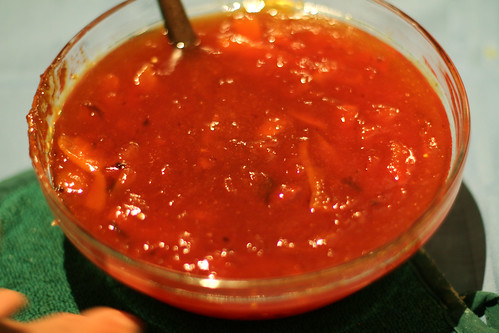
Doce de papaia | Papaya jam | Recipe

I kept seeing this recipe pop up, so I had to do it. Most recipes implied that you need a fairly unripe papaya, but I couldn't find one so I just made this with a big ol' normally-ripe papaya. We cooked it all throughout dinner, so by the time dessert came around the dish got really red, the sugar got thick and even a bit caramelized, and it was a marvelous topping for the pudim. It's also versatile: we had it on french toast with yogurt for brunch the next day, and it was awesome.

That's it for this little island country. Next weekend we're back on the African mainland, to the heart of it in fact with the Central African Republic. We've been planning the recipes with some pretty knowledgeable sources that we'll tell you all about next time!

Photos by Laura Hadden, who's looking forward to putting papaya jam on everything for the next few weeks.

The secret is out!

On the heels of our biggest meal yet for Cameroon, we've gotten our first publicity! Mary-Katherine from the State Department's Bureau of International Information Programs caught wind of our project, pitched the story to her editors, and even got an extension on her deadline so she could attend our meal in DC for some first-hand reportage. We're really happy with the article, which you can read in both English and French. The latter is a delightfully florid interpretation, with turns of phrase such as "Ils attaquent les pays (à la fourchette, bien sûr) par ordre alphabétique," or literally, "They're attacking the countries (with a fork, of course) in alphabetical order."

Keri Kae at the WFP USA also wrote up a blog post about the meal and included us in their April newsletter. They're encouraging others to cook international dinners as a fundraising effort, which I think is a great idea. To that end, I plan to write up some posts about what I've learned about recipe research, shopping, and planning the cooking day. And if there's anything in particular you'd like to hear about, please let me know below!