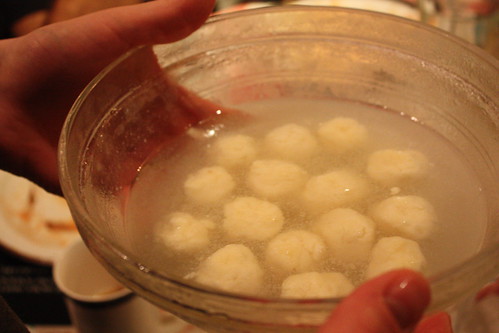
Noshies: Best of the A's

We're sure learning a lot about the foods of the world, and we definitely have our favorites and our wouldn't-do-agains. Laura and I present to you the first of several rounds of the Noshies, our cheers and jeers for the foods we've cooked, eaten, and cleaned up after. Going forward we'll do these after every letter or two. Best cuisine: Argentina, runner-up Afghanistan
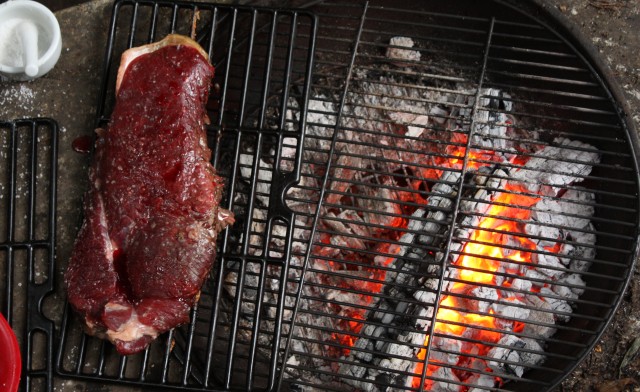
It's said that Argentina has no cuisine, only beef. But damn, that beef is amazing, simply salted and grilled indirectly with wood coals. Also, the flow, with round after round of grilled food, made for a really special dinner party. Afghanistan also made a great showing, with wonderfully balanced flavors, textures, and colors.


Best drink: Rakia (Albania), runner-up Armenian brandy
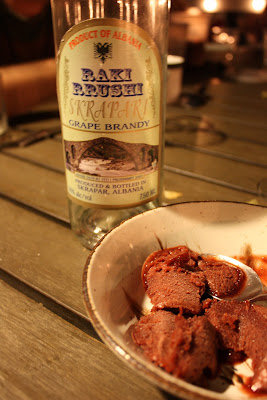
According to Rudina, our Albanian guest, rakia is used for pretty much everything, from fever to festival. With a brandy this smooth and delicious, I'd be willing to try. And amazingly, no hangover. Armenian brandy is also really nice, with a nice amber color and richness.


Best dessert: Pakhlava (Armenia), runner-up Anzac Biscuits (Australia)
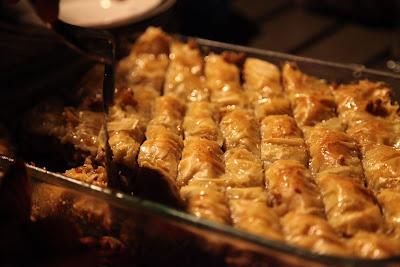
Crispy, buttery fillo drenched in flavored sugar. Pakhlava was really as good as it sounds, and came out beautifully to boot. No wonder so many countries have a dessert like this! The Anzac biscuits were rich, well-balanced, and utterly addictive.


Best main dish: Asado de tira (Argentina), runner-up Tavë Kosi (Albania)
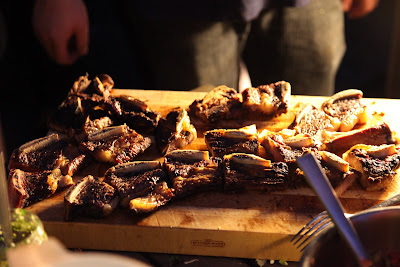
This is kinda like winning best film and best actor at the same time. And these cross-cut, grass-fed, wood-grilled ribs, crackly on the outside and rich and juicy on the inside, made a star performance. For the runner-up, we had a choice of several excellent lamb dishes; the yogurty goodness of the Albanian casserole came on top.


Best side dish: Borani Banjan (Afghanistan), runner-up Erdäpfelsalat (Austria)
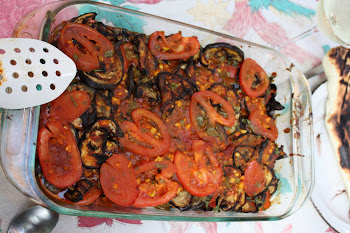
Garlic and spices complementing tomato and grilled eggplant in this casserole makes for just about all you could ever ask for in a side dish. The potato salad, warm with a meaty, tangy sauce, made for a really lovely, simple dish courtesy of Austria.


Best condiment: Chimichurri (Argentina), runner-up Narsharab (Azerbaijan)
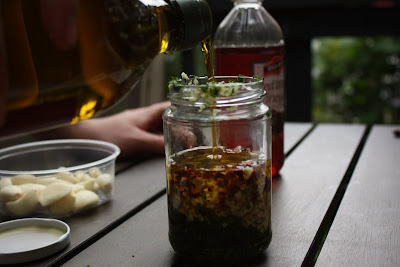
It's hard to imagine many things that could possibly improve slow-roasted meat, but this mix of garlic, parsley, vinegar and olive oil was a huge hit that we'll surely make again. In a very different direction, the pomegranate molasses is like one part sweet to two parts tangy, and pairs so well with lamb.


Best bread: Tendir choreyi (Azerbaijan), runner-up Nan (Afghanistan)

The so-called tandoori bread is on the flat side for an oven-baked bread, kind of like a ciabatta, with a great crust and spongy interior. The grilled nan was lovely, with yogurt for richness.


Worst dish: Escudella (Andorra), runner-up Vegemite on toast (Australia)
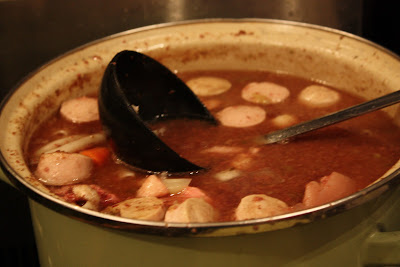
Sorry to any Andorrans, but this stew was a whole lot of nice rich ingredients that turned into an uninteresting bowl of weird meat chunks and like five types of grain. And Vegemite, the spreadable yeast extract, well, it was just pretty nasty, guess it's something you have to have grown up with.


Most difficult: Samani halva (Azerbaijan), runner-up Kaskasu bi'l-Lahm (Algeria)
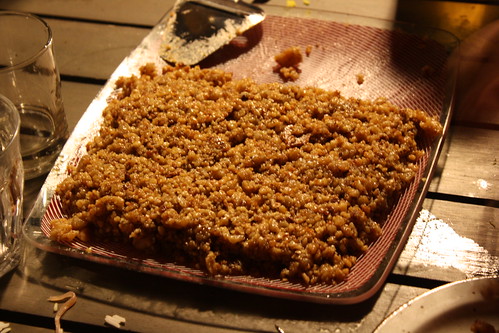
Sprouting the wheat was tedious enough, but extracting the malty juice was really tough, and then I had to stir it for hours on end before it turned into a mush that I couldn't make into balls as the recipe called for. As for the couscous, the stew part was easy enough, but the recipe I followed for cooking the starch called for five hours of really tedious moistening and drying and raking with my hands, all for something that didn't seem to me a whole lot different from just pouring in boiling water and covering.


Most exotic purchase: Red palm oil (Angola), runner-up Armenian string cheese
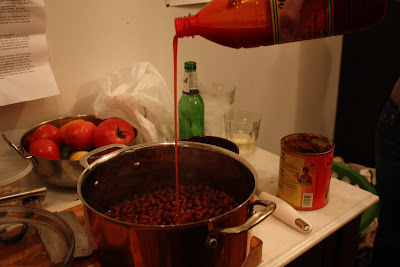
Red and grainy and opaque and super-thick, with a distinctive nutty flavor, red palm oil was an avalanche of thick oiliness throughout the Angola meal. On the more fun side, the string cheese was not only a delight to unwrap and peel into strands, but it was also really yummy.


Most fun to cook: Aussie burgers, runner-up Funge (Angola)
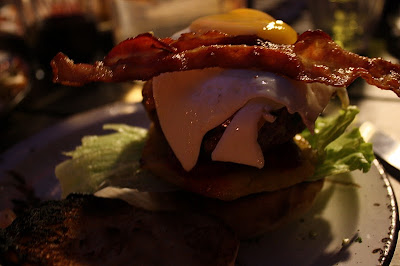
This is probably the only hamburger I've ever seen that's taller than it is wide! Stacking up a fried egg, grilled pineapple, pickled egg, cheese, bacon, lettuce, and tomato in an assembly line was a real blast. The funge, on the other hand, was just a unique experience, what with sitting on the floor and wildly whipping cassava flour and boiling water into a thick starch.


Best music: Austria

This one is ridiculously culturally inaccurate, but we had a really fun time singing along with The Sound of Music with Laura's family. (This photo is my mother-in-law's head on Julie Andrews' body.)


Best cultural activity: Peeling a pomegranate (Azerbaijan)
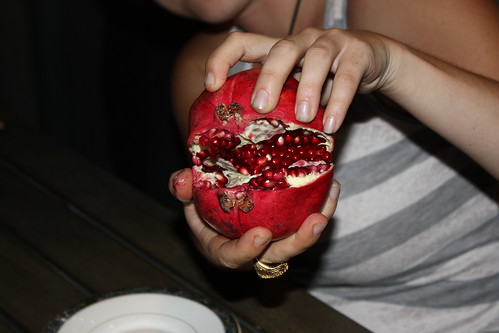
As Marsha taught us, at the end of a meal, it's great to linger with friends and family, and slowly peel and eat a pomegranate. You have to do it slowly to avoid squirting yourself with the staining juice, so it's kind of a forced relaxation.


Most pleasant surprise: Dough (Afghanistan)
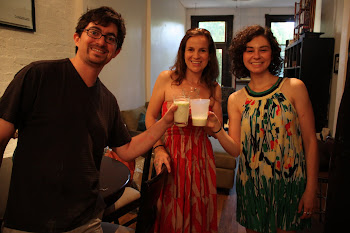
Salty watered-down yogurt with cucumber chunks doesn't exactly sound very appealing to the Western palate, but I'll be darned, it was really pretty refreshing and not half bad.

That's the first of the Noshies! Stay tuned for the awards for the B's, probably sometime around late March.

Week 17: Belgium


It's been said that Belgium cooks food at French quality in Germanic quantity. This happy duality befits the split nature of this small country: the Flemish of the north speak a dialect of Dutch, the Walloons of the south speak French, and they all eat well. (For the purposes of this post I'll give the menu item names in French, if for no other reason than that I'm a lot more familiar with it than Flemish.)

When I was thinking ahead to Belgium, I figured we'd enjoy good beer with mussels, fries, and waffles. Turns out my assumptions were entirely correct, plus a few additions seasonal to the time of year. Our guest of honor on this delicious journey was Chris, who led us through a beer tasting paired with the meal. We also had on hand Chris' friend and my coworker Caro; another colleague Ginny in town from DC; Lauren and Lauryn who each brought a waffle-maker; and Laura's classmate Cassie. And in absentia, Laura's sister Jen, whose experience from a year and a half in Brussels helped us on the right path.
Bière | Beer

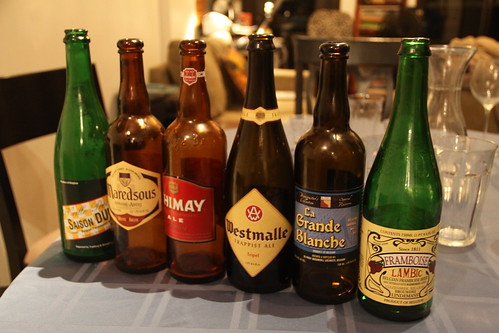
There's nothing like a Belgian beer: rich, balanced, flavorful, and each one distinctive. As you see, we tried six different ones (albeit one of them, the Maredsous, in the form of stew!), and with Chris's coaching learned a bit about them. The Dupont is in the saison style, with "only" 6.5% alcohol, was developed because workers were getting too drunk on the beer they normally drank (ya know, because water was unsanitary back then). Chimay and Westmalle are brewed by Trappist monks, two of only seven Trappist ales produced — the Chimay is a nice rich color and balanced, and while the Westmalle looks unassuming, it packs a punch of both flavor and alcohol. La Grande Blanche is a wheat beer, and the Lambic is a beer brewed without hops, so its lack of bitterness helps it take very well to the raspberries.
Moules | Mussels | Recipe (scroll down)

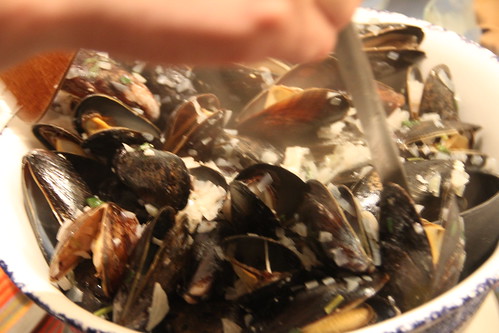
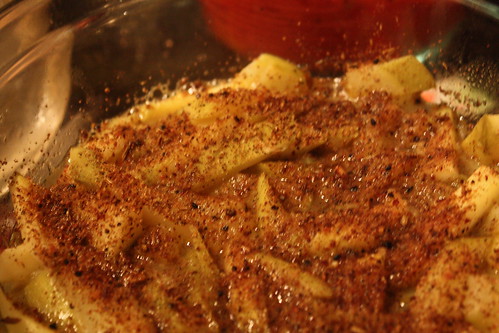
While normally I love to get creative, and for sure there are various creative recipes with blue cheese or curry or whatnot that you could find, when it comes to mussels there's just no way to improve on the classic moules marinière: simply steamed with sautéed shallots, parsley, and wine. Unlike oysters, there's no need to shuck; if they're fresh, they simply open. And thankfully that means we don't have to eat them, shell and all, like a starfish does.

Frites | Fries | Recipe

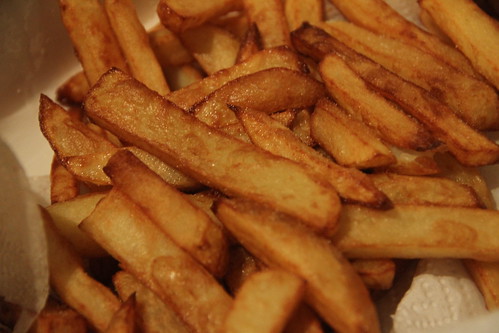
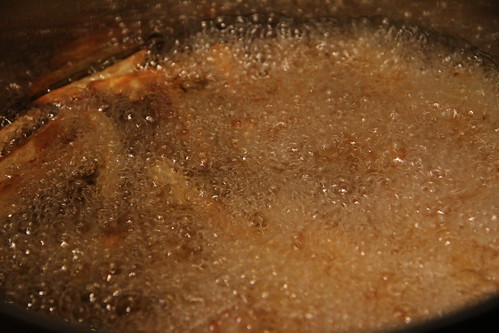
The classic Belgian pairing with mussels is fries, in fact they simply mush the names together and call it moules frites. Belgium proudly, and rightly as far as I can tell, claims to be the orignal home of the poorly named French fry. I did my best to do it right, by rendering some beef fat (albeit a small amount — there was only so far I could prod the butcher at Fairway!), blending it with vegetable oil, and then frying in small batches in two stages: once at a lower temperature to cook the potato, and then at a higher temperature (video!) to get the crisp. Whether paired with Ginny's aïoli or dipped in the mussel juice, yum.

Fromage | Cheese

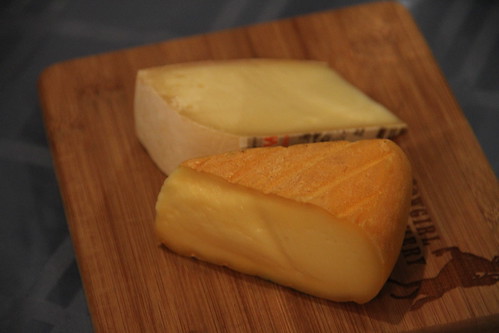
The cheese in front is from Chimay. In fact, the mash left over from brewing the beer is fed to the cows who make this cheese, which is nice and rich and gooey. Can't remember the name of the one in the back but it was good: semi-firm and with a medium ripeness.

Pain | Bread

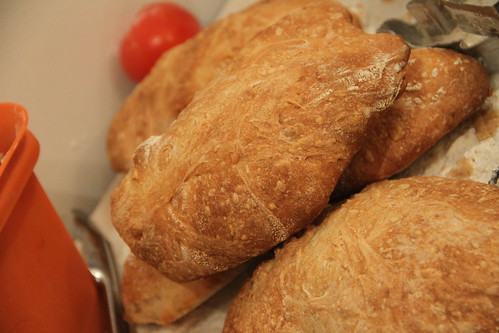
I tried to make baguettes using the poolish pre-ferment recipe in the appropriately-named cookbook Bread, but I made one crucial mistake: I added flour and then the poolish to the mixing bowl, instead of the other order. When I came back an hour later to fold the rising dough, I found that the flour on the bottom hadn't gotten mixed in, so the wet part was way too wet. Long story short, it never got nearly solid enough to make into baguettes, so I flipped to the ciabatta recipe, since ciabatta is a much wetter dough. This bread wouldn't win any design competitions, but heck, it was crusty, with good spring, and did a bang-up job sopping up sauces.

Carbonnade à la flamande | Beef and beer stew | Recipe


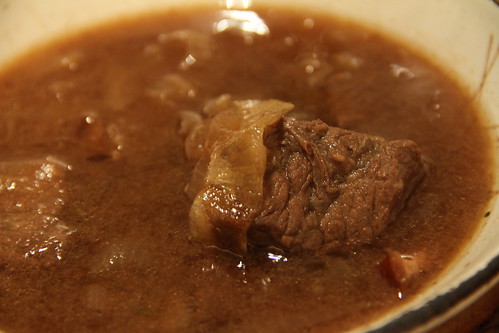
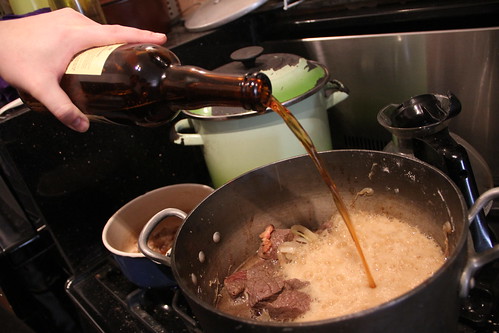
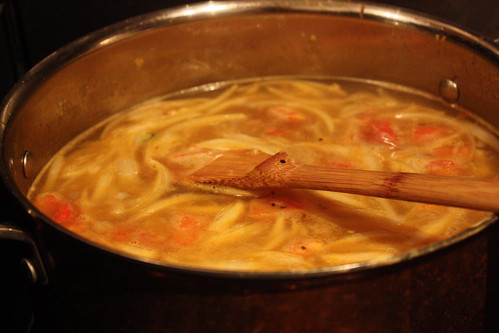
Onto the main course!  This was perhaps one of the easiest big dishes I've made for United Noshes, nothing much more than beef, onion sauteed in bacon grease, beef stock...and Belgian ale! Simple, and a crowd-pleaser. Do try this one if you're so inclined, it's a lot of flavor for not much effort. I wouldn't recommend putting in as much liquid as the recipe calls for, since it ended up more like soup than stew, but it's up to you.

Endives braisées | Braised endives | Recipe

Endives were discovered, crazily enough, fewer than 200 years ago. Apparently it's a weird offshoot of light-deprived, over-wintered chicory, or something. Anyway, braised with little more than butter, lemon juice and sugar, a really rich, slightly bitter and complex flavor emerged that nicely counterbalanced the rich meat.

Speculoos | Holiday spice cookies | Recipe (first one in comments, in French; translation below)

December 6 is the feast of St. Nicholas, which is a big holiday for Belgian families. The traditional sweet is the oddly-named speculoos, which derives from Latin; depending on whom you ask, it comes from either the word for "spices" or for "mirror." The spices part is obvious: along with copious amounts of butter, raw sugar, and some ground-up nuts, these guys have cinnamon, nutmeg, and sometimes pepper and clove and other spices. The mirror part would refer to the imprints of animals and human figures; alas, without a speculoos mold of my own, I resorted to cookie cutters. Really yummy. See my transcription of the recipe below.

Gaufres de Liège | Caramelized-sugar waffles | Recipe

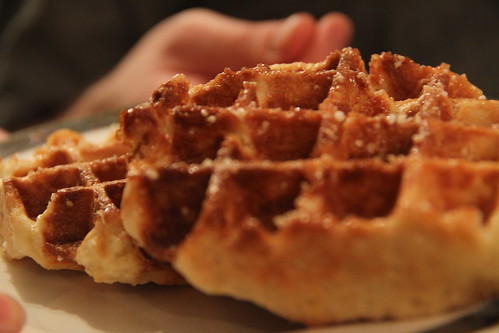
The more I do this United Noshes thing, the more I realize that dessert dishes often take the longest. First I had to brave the 2-star-reviewed specialty cake shop for non-dissolving pearl sugar. Then I had to give the batter a 75-minute rise, some mixing, a 4-hour rise, a 30-minute refrigeration, and folding up before refrigerating. Then finally, the Laure/yns mushed in the pearl sugar, and after one last 90-minute rest, it was off to the waffle-makers. And you know what? Totally worth it. The sugars, with a lot of help from the (you guessed it) absurd amounts of butter, got all perfectly caramelized on the edges. (Speaking of: today at Fairway, in preparation for some seasonal cookie-making, I bought like five pounds of locally-made butter, for no more than the commercial kinds. A new trend?)

We enjoyed some Belgian music, mostly old-timey French-language tunes, and scratched off the map for both Belarus and Belgium. We're taking a week off for finals and cookie-making (guess who's doing which), and then we're back in the Caribbean for a terribly punny special event...

~~~

Speculoos (translated from here)

350 grams flour

250 grams butter, almost melted. (Note from OP: use very high quality butter, otherwise the speculoos aren't as good)

250 grams of real cassonade (Jesse's note: this is a raw beet sugar, not the same as brown sugar which has added molasses. Closest in the States seems to be turbinado sugar, like Sugar in the Raw.)

50 grams powdered almonds

50 grams hazelnuts (Jesse's note: didn't say powdered but I did anyway, otherwise what would you do?)

1 egg

1 tablespoon nutmeg

cinnamon (Jesse's note: I used about 1/2 tablespoon nutmeg, 1/2 tablespoon cinnamon, a few pinches of cloves and some ground black pepper, based on what I'd read from other recipes)

2 chemical leavening (Jesse's note: equivalent to 2 tablespoons baking powder)

1 teaspoon baking soda

Mix all the ingredients into a big, beautiful ball. Refrigerate overnight. Roll and cut (or if you're super-fancy use a speculoos mold but if you have one of those why are you reading my translation?). Bake at 350°F for 15 to 20 minutes. They'll be a bit soft when you take them out of the oven but they'll firm up when cool.


Week 16: Belarus

(Above: Google Translate into Belarussian of, "Cheers, bitches!")

Belarus is in the heart of Eastern Europe, bordered by Russia, Lithuania, Poland, and Ukraine, a forested, landlocked country with long, cold winters. It should be no surprise then that potatoes, sour cream, rye bread, pork, and vodka form the core of the cuisine.

This was our first United Noshes on the road, back in my former apartment in San Francisco. The big common space and excellently appointed kitchen (save for the comically small sink) make it easy to cook (and drink!) with friends. Our host was Jon, and guests were Alicia, Zoe, Kayla, Matt, Bryan, Cole, and Michael; Liz joined us after the meal.

Rye bread | Recipe

Conditions in Belarus are not favorable for growing wheat, and rye is the king of grains there, so rye bread it was. I couldn't find any recipes specifically for Belarussian bread, but I did find some for the classic Russian dense dark bread with coriander known as borodinsky. Most had all sorts of improbably ingredients like instant coffee crystals to fake the darkness and rich flavor, but those had "copout" written all over them. A few were simpler but called for malt syrup. And then I found it: a method using 80% rye to 20% bread flour, including homemade malting and leavening with sourdough starter. Of course there was starter lying around here, but it was in the fridge and that was a big gamble.

It took several hours longer than the recipe called for both to ripen the mix with the starter and to proof the loaf, but in the end it was a total success. It might have ended up on the denser side, but the flavor was rich and malty and with the tangy complexity that comes from a long, slow rise. The part of the second loaf that survived until the next day became even tastier, with more complex flavors developing. And in all cases, it's excellent with a slather of butter.

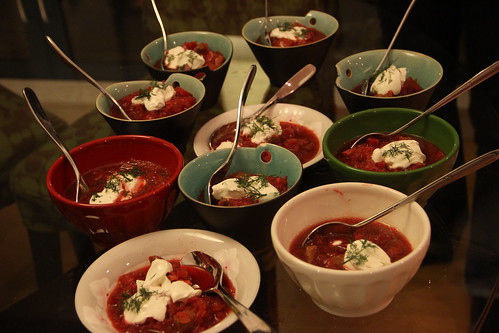
Borscht | Beet stew with beef | Recipes: beef stock, soup

The most famous Belarussian soup is a chilled one called chaladnik, but it just didn't feel right to eat cold soup in late fall. Instead, we enjoyed the local version of the well-known beet soup, this one having tomatoes, shredded cabbage, and chunks of beef. This took just about the whole day: I was the first customer at the Hispanic market around the corner at 8 AM for beef neck bones, which I roasted for a few hours before simmering for five hours. Then in went the beef and veggies, and after two more hours, it was time for this first course. With a dollop of smetana, a sour cream with a tang like crème fraîche but thick like American sour cream,  this soup was rick and nicely textured and surprisingly complex. Even Laura, who hates beets, claimed to enjoy it. Went so well with that bread.

Krupnik | Vodka cordial | Recipe at end of post

A few weeks ago, I met someone whose parents emigrated from Belarus. She asked her mother for recipes, who refused to give most of what she knew on the basis of not thinking the food was very good. Too bad! But she did give the recipe for this warm drink of honey, spices, and vodka. Sooo good! It's like what a hot toddy is trying to be. We ended up making two batches, going through the whole handle of vodka. Check out the video!

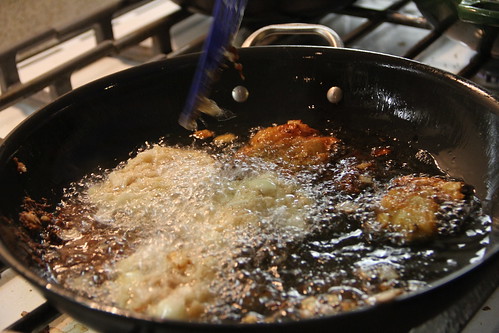
Draniki | Potato pancakes | Recipe

Like latkes, but more annoying to make. Instead of grating the potatoes on the big side, you use the little pokey ones so you end up getting a starchy mush. Mix with egg and onion and fry as expected. Apparently these are really popular there. Big thanks to Kayla, Bryan, and the others who grated!

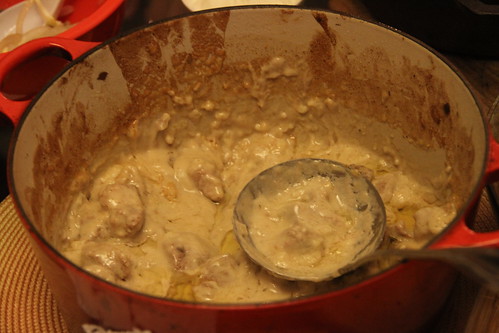
Machanka | Pork stew | Recipe

I started with bacon, which I cooked to a crisp over the course of an hour to render out the grease. Then I separately fried pork, onions, and a flour roux in three separate frying pans, added that smetana cream to the flour, and mixed it all up together with beef broth before baking it all off. Not the best looker, and rich like whoa, but so good with the draniki and the bread.

Mushrooms with onion gravy Recipe (search on page)

The damp forests of Belarus are excellent breeding ground for mushrooms, and they figure in a lot of dishes. This was a simple and really nice dish, really not much more than sauteeing whole mushrooms on high heat in one pan, and softening onions and mixing with smetana in the other. Mix 'em together, and blammo, you've got a nice side dish.

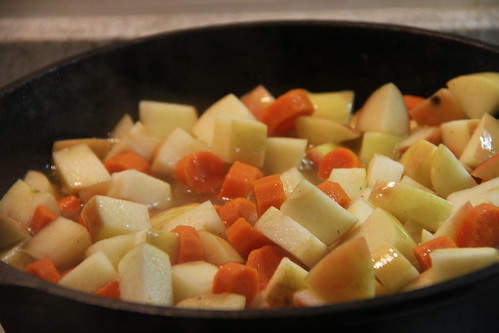
Carrots stewed with apples | Recipe (search on page)

The whole meal felt a bit lacking in the healthiness department, so I went with this simple and nice recipe of simmered carrots with apples. Felt right for the fall season.

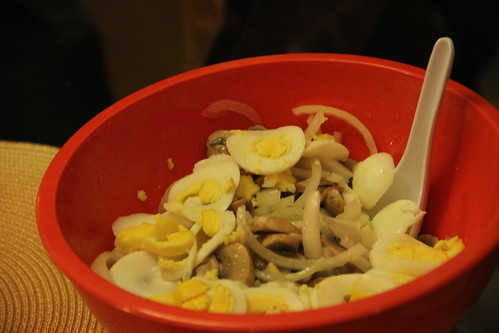
Mushroom salad | Recipe

For some reason I thought two mushroom dishes would be a good idea. This simple salad based on boiled mushrooms was ok, but just didn't have enough flavor to be all that exciting.

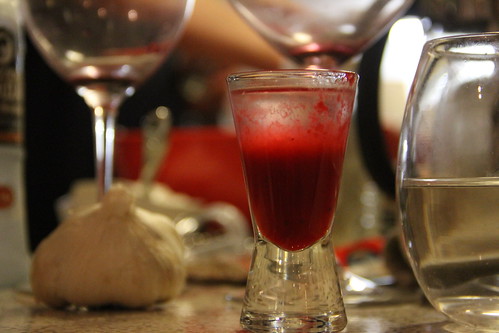
Cranberry kisiel | Thickened cranberry juice | Recipe (search on page)

I don't think Belarussians mix this with vodka, but we did! This thick juice, made with mashed, boiled, strained and sweetened cranberries, went nicely with a cold splash of vodka.

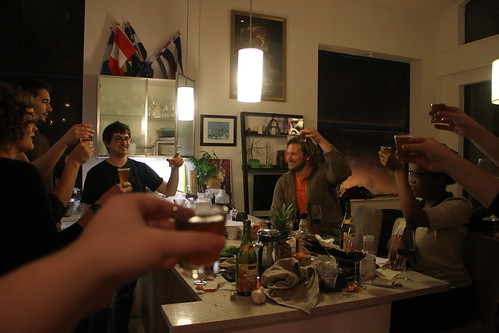
As you'd expect, with all this vodka, we had a marvelous time. Especially Michael, who passed out right after the meal on the couch in the background:

Thanks to all who came and donated, making this the biggest evening yet for the World Food Program, and pushing us over the $2,500 total mark.

Next week it's back to Brooklyn, and onto the beers, fries, mussels and chocolate of Belgium!

~~~ Krupnik 1 1/2 cups honey 2/3 cup water 1 teaspoon vanilla extract 1/4 teaspoon nutmeg 8 cinnamon sticks 2 whole cloves 3 strips lemon peel 1 bottle  (4/5) quart  vodka

1.   Combine honey with water, vanilla, spices, lemon in a large saucepan.  Bring to a boil; cover, simmer 5 minutes. 2.   Add vodka. Remove from heat.   Serve hot or cooled.

Week 15: Barbados

Barbados is forever connected to rum — they've been making it there for over three hundred years, probably for nearly as long as it was a British sugar plantation colony. So because given this was our third Caribbean meal, and perhaps because the previous two countries were Muslim, I focused a bit more on the drinking side of things, making two drinks from scratch that are classically Bajan (BAH-zhun, the colloquial term for Barbadian).

Our guests tonight were Elly, her visiting friend Tasha, Alexis, Dan, and Raven. To shop for this meal I took advantage of the unseasonably mild weather to bike out to the southern end of Crown Heights, to a fish store and a produce shop.

Falernum | Recipe

This mildly alcoholic sweet liqueur, pronounced fah-LEARN-um, is a rum infusion of cloves, lime peels, garlic, almond extract, lime juice, and lots of sugar. It's got a really nice and complex aroma, and help prove that rum doesn't have to be mixed exclusively with fruit juices — for example, try the basic rum swizzle.

Ginger beer | Recipe

Really simple and with a big payoff. It's just about as simple as mixing grated ginger with yeast and a few other things, and letting it sit for a few days. The result is precisely that crisp and lightly spicy and sweet taste you expect from those fancy ginger beers. I made this one in the fridge with a loose lid, so it wasn't bubbly; next time I'll try a recipe that's made sealed in a bottle to preserve the combination. And there will be a next time.

Fried flying fish | Recipe

So, I had to cheat. I biked all the way out to Crown Heights to a fish market down the street from a Bajan restaurant, and they didn't have flying fish. Turns out that this national fish of Barbados just doesn't travel well. So I used cod instead. It was nice enough (when isn't fried fish a good thing?) although somehow my breading didn't stay on, and it's also hard to really get the feel of a simply prepared fish if it's not the right fish. Note for the future to perhaps err on the side of a meat if I can't get the right fish. Have to say, though, that with the homemade hot sauce, it certainly had plenty of flavor.

Cou-cou | Recipe

Remember the funje from Angola? Well, this is pretty much the same mush dish, but with corn instead of cassava flour, plus a bit of okra. Thick enough to stand a spoon in.

Macaroni pie | Recipe

Some forums I came across discussed how cheddar cheese just didn't quite replicate the right taste from the Caribbean, so I was thrilled to find cheese from nearby Trinidad at the market. This isn't a standard macaroni and cheese; yes, it's got elbow pasta and grated cheese, but also onions and bell peppers and mustard and a blend of seasonings from cloves to paprika. I made a big batch and it was all gone!

Conkies | Recipe

This dish is so similar to the ducana from Antigua and Barbuda that I meant to skip it in favor of some other dessert, but two things swayed me. One, there were like no veggies in the main dish so the sweet potato and pumpkin in this dish helps a bit. And two, conkies are the traditional dish for Barbadian Independence Day on November 30, and since we're so close to that day, I just had to. Now, I'm not very dextrous with precision work, so I'm glad that Elly, Dan and Raven pitched in to take the sweetened and spiced batter of shredded veggies and coconut and carefully wrap it into banana-leaf bundles. I'm glad we made these: they were more tender and subtle than the last ones!

The drinks were flowing, the Rihanna was blasting (did you know she's from Barbados?), and the apartment was warm enough to evoke a Caribbean evening.

Our next stop around the world is Belarus, and we're taking it on the road to San Francisco over Thanksgiving weekend.

Week 14: Bangladesh

It's apparently well-known across the Subcontinent that Bengalis take their cooking and eating very seriously. In fact, most Indian restaurants you have eaten at were probably actually run by Bangladeshis. (At the risk of greatly over-simplifying, Bengali refers to both a language and a culture, whose homeland after the partition of 1947 upon Britain's departure was split into the mostly Hindu state of India of West Bengal whose capital is Kolkata; the mostly Muslim eastern portion of Pakistan, which gained independence in 1971, is now called Bangladesh.) Bangladesh is the world's eighth most populated country at around 145 million, and ninth most densely populated, with 2,559 people per square mile. That's almost 31 times more dense than the US.

Straddling the delta of of the great Ganges-Brahmaputra river system, Bangladesh's food features fish and rice as staples. But since several of our vegetarian friends hadn't been able to fully enjoy a Noshes dinner so far, we decided to take advantage of the ample flesh-free options of Bangladeshi cuisine. So at the Bangla Nagar Grocery in Kensington, Brooklyn, which accepts Bangladeshi taka, I steered away from the fish and meat counter, and instead delved whole-heartedly into the vegetable section full of bizarre-looking specimens. I also made sure to try a fish dish at the restaurant next door, which was delicately flavored, moderately spicy, and riddled with seriously dangerous bones.

Our vegetarian contingent tonight featured two classmates from high school I'd not seen in ten years: standup comedian Emily Heller and her friend Sam, as well as Michelle, Zach, Christen, Sean and Sophie. We all diligently ate the meal, most of which was seasoned with judicious dabs of pungent mustard oil and smatterings of the panch phoron (five-spice blend), with our hands.

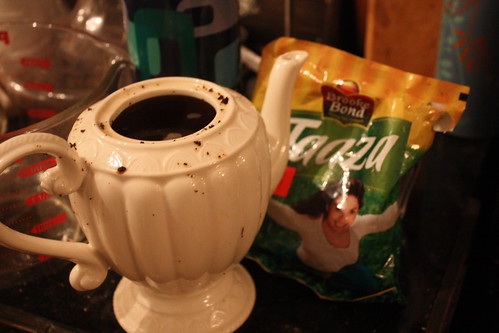
Cha | Tea

Rudina, two-time Nosher, just happened to go to Bangladesh recently, so I asked her how they take their tea. Turns out it's milky and very sweet. So that's how we had it, made with loose Bangladeshi tea that I randomly pulled from the shelf. It was tasty and the caffeine is still powering me, a few hours later.

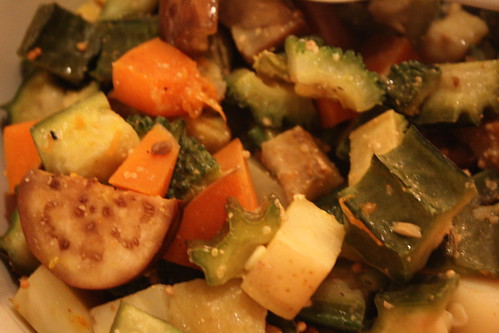
Shokto | Vegetable simmer | Recipe (I added pumpkin as suggested elsewhere)

Apparently there's a common saying that you shouldn't eat shokto at night, but nobody knows why. But this dish seemed so important to Bangladeshi cuisine, and also big on vegetables and meat-free, so we went for it. It also was an opportunity to use those funny veggies, like bitter melon, ridged gourd, and green cooking banana. Whew, pretty intense! It was our first encounter with the mustard oil that graced pretty much every dish. Some of the veggies were nice, like the pumpkin, but the bitter melon was too accurately named even for my adventurous taste.

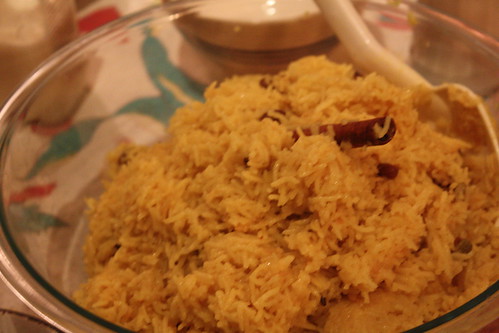
Pulao | Bengali pilaf | Recipe

It was perhaps a bit too much water, but gosh it was tasty. With a little pre-saute of raisins and spices, chilies for a little zing, turmeric for a bold color, and a sprinkling of sugar, this was a nice counterbalance to the heady vegetables. This plus the shokto constituted the first course.

Masoor dal | Red lentil stew | Recipe

Again with too much water, but this dal had a lot more flavor than most I've tasted. (A little too much for some, it was kinda spicy.) Despite the common advice to eat with fingers, we couldn't figure out how to do it with this soupy bowl, so we cheated with spoons. I forgot the lime juice, that would have been nice to zing it up a bit.

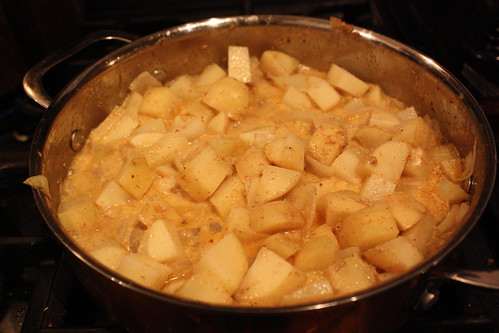
Alu posto | Potatoes with poppy-seed paste | Recipe

Poppy seeds are a distinctive part of Bengali cuisine, and alu posto is the dish par excellence to show it off. With just a bit of chili powder and mustard oil, this was a relatively simply spiced dish that paired nicely with the more complex dal. Interestingly, the poppies of Bangladeshi food are 95% white, rather than the 100% black ones we get here.

Tomato chatni | Recipe

A chutney is a sweet, almost jam-like goop that keeps forever in the back of the fridge, right? Well, not to Bengalis. It's a lightly sweetened, freshly made course that goes between the main meal and dessert, as a kind of palate-cleanser. As if to highlight the crossover nature of this course, one of the classic Bengali chatnis is made with tomatoes. The mustard oil and spices keep one foot in the savory side, the palm jaggery (a distinctly-flavored compressed sugary thing) sweetens it up, and the tomato flirts heavily with both sides, as befits a fruit that most often acts like a vegetable.

Kancha aamer chatni | Green mango chatni | Recipe

I was only planning to make the tomato chatni, but when I saw the green mangoes at the market, I had to get them. (I also got a green papaya that I hope to do something with this week.) This works for the same reason as the tomato chatni, but in the opposite direction: normally rich and sweet, this fruit acts like a tart veggie when under-ripe. On top is a dusting of toasted and ground panch phoran spices.

Rasgulla | Fresh cheese balls in syrup | Recipe

It blows my mind a bit that it's so easy to make cheese, at least the very basic versions. Boil milk, add citric acid, drain the whey, squeeze it through cheesecloth, and boom, you've got your curds. In this case, one liter of milk yielded sixteen little balls, which I then boiled in clarified sugar water until they puffed up. Imagine if feta cheese were sweet instead of salty, packed in syrup instead of brine. If that sounds good to you, then you'd like this.

Guided by Sean's excellently curated playlists of Bangladeshi DJs and pop music, we then cracked into some store-made sweets that were all variations on the theme of taking dense dough and dousing it in sugar water. Density surrounded and at times inundated by water: cuisine mirrors geography.

We're taking off again next week, and will be returning to the Caribbean with a meal from Barbados on the 20th.