Week 13: Bahrain

One of the unexpected discoveries of cooking around the world has been learning just how many different ways there are to cook rice, far beyond the basic boil-then-simmer that a rice cooker does.

For example, parboiling, as I've learned, involves cooking it quickly in a rolling boil for a few minutes, until it's soft on the outside but still crunchy on the inside. Then you drain it, and then either put it in another dish or cook it on its own to finish. This Bahraini meal features basmati rice parboiled rice two ways: seasoned and put into a chicken dish, and boiled in caramelized sugar water.

This cuisine also involves a lot of stirring. Stirring whole spices as I toasted them in a pan on the grill outside to prevent the house from getting smoky. Stirring plain sugar until it melted into a caramelly goop. Stirring green coffee to lightly roast it. It's enough to make you stir crazy.

Three of our guests were from my college dorm: Sarah, Sebastian, and Jeff. Also there were Jeff's girlfriend Elly, and Sophie and Henry.

Sala6a | Salad | Recipe

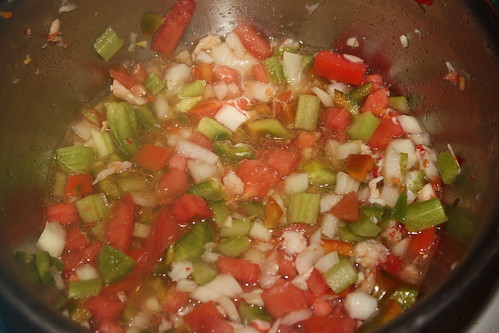
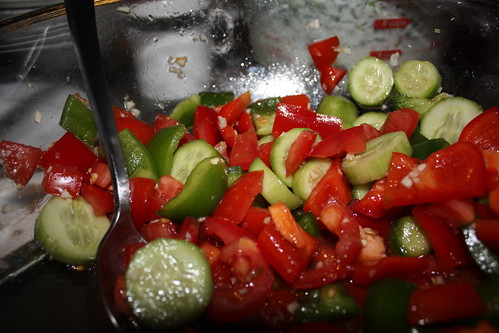
Did you know there's a whole colloquial system for writing certain difficult-to-transliterate Arabic letters onto a Western keyboard? Check it out. The 6 is pronounced kind of like a T, but it's pharyngealized, so I think you should kinda swallow as you say it. Anyway, this was a nice light salad with a lime juice vinaigrette, featuring parsley and mint to freshen it up. Thanks to Sophie and Elly for getting the dressing just right.

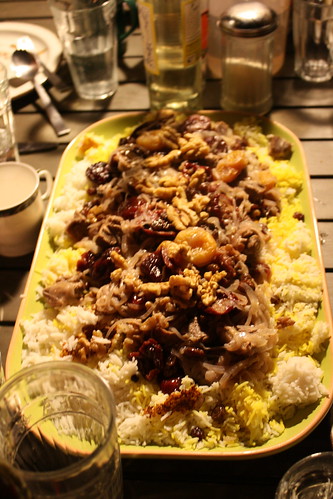
Mechwi jader | Upside-down chicken-rice cake | Recipe

This was nice enough, but given all the time and spices that went into it including exotic things like dried limes, I expected more flavor. Also, it was supposed to kind of solidify into a cake, but even after Sebastian expertly inverted the contents of the pot onto a platter, it just kinda slumped. Maybe there was too much liquid? Anyway, it was not bad, and that parboiled basmati rice had a nice bite, but I feel like I kinda missed the magic.

Fried fish with bezar spices | Recipe for bezar
Remember how I found some other round-the-world cooking projects when looking up Andorran food? Well, I'd found lots of evidence that fried grouper is a big thing in Bahrain, but precious little guidance on how to do it, and that's what led me to Cooked Earth. This guy Mark is doing an awesome job, with amazing attention to detail and gorgeous photography. It's going to be hard not to just follow in his footsteps, but a) I want to learn by doing research for myself, and b) he's going at a slower and steadier (and better researched!) pace, so I'll probably pass him soon. He most recently did Benin.

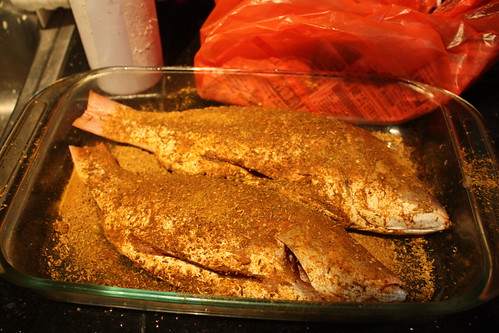
So anyway, I took Mark's suggestion to use a bezar spice blend rub on fish. Couldn't find a decent and fairly priced whole fish resembling grouper in the neighborhood, so I hopped on my bike for Sunset Park, Brooklyn's answer to Chinatown. I ended up with snapper that was really fresh at a fair price, and expertly scaled. (Speaking of scaling: wow, getting to 8th Ave involves quite the hill! I'm still feeling that climb in my legs.)

The bezar, made of whole spices like cumin, fennel, coriander, cinnamon and more, was quite a hassle. It took nearly 45 minutes on the grill outside in the dark before it got toasty enough. Then the hard part began. It turns out that cinnamon sticks just will not be ground by a Cuisinart, which I learned the hard, noisy, and long way. In the end I cheated by pulling out the sticks and using pre-ground cinnamon. And I ended up with a quart of the stuff!

The result, however, was worth it. I slipped the spice-crusted fish into my big skillet with two cups of clarified butter and some added vegetable oil for good measure. It fried up super nice, about ten minutes on each side, making a luscious buttery-spicey crust. The bones were picked clean. That bezar, which has a bit of an acrid and sharp nose, turned so rich and flavorful once cooked.

Muhammar | Sweet rice | Recipe

Man, I would eat this dish a lot if it weren't such an involved process. First you wash and soak the rice, then it takes about a half hour just to melt the sugar (with a weird intermediate lumpy phase), and then you have to parboil the rice, drain it, and continue cooking it on low heat. But man, the caramelly color and flavor just make it amazing. Despite the two cups of sugar it's not too sweet (remember, you drain the sugar water), and it was an amazing balance to the richly spiced fish.

Qawha arabeya | Arabic coffee | Recipe (we omitted the sugar)

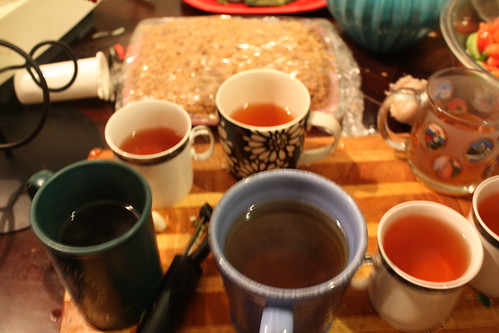
Coffee is the sign of hospitality in this region, so despite the dangers of Sunday night caffeine, we did it. Thanks to Sahadi's for the green coffee beans, which Sebastian roasted on the stovetop until they turned brown, and then Sarah and Elly smashed when it turned out the Cuisinart couldn't grind them. (Note to self: food processors don't grind stuff well. Get a grinder or a spice mill or something like that.) Blended with cardamom and a bit of saffron, it made a heady brew that was somewhere between coffee and chai: with the spices and the very light roast it was far from a classic coffee. I wish I could have enjoyed more without the fear of never falling asleep, 'cause this stuff gets you wired.

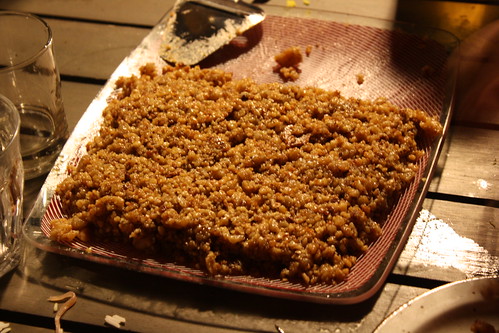
Khabeesah | Semolina cardamom pudding | Recipe

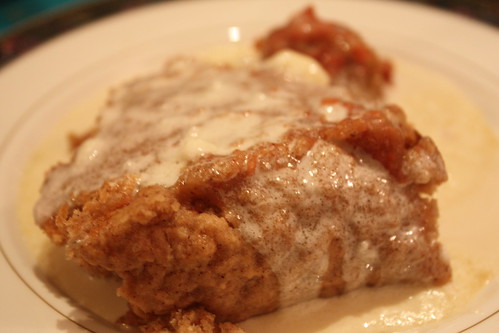
I just couldn't find any good description, let alone recipes, for "halwa showaiter," which is supposedly Bahrain's famous treat. But I figured that if khabeesah was good enough! I followed most of the modification recommendations on the linked recipe, except that replacing condensed milk with maple syrup just seemed quite out of place. This dessert turned out quite nice, not too sweet and nicely perfumed. A great accompaniment to that coffee.

We sent our guests home with some of that bezar spice mix, but not before press-ganging a few of the into helping us remove the air conditioner, a true admission of the changing seasons.

Next week we head across the Arabian Sea and over the Subcontinent to Bangladesh, yet another place on the sea with a British colonial legacy.

Week 12: The Bahamas

The word Bahamas is attributed to the Spanish "baja mar," or under the sea. Accordingly, seafood was a prominent factor in this meal. Amazing we got through eleven meals before cooking fresh treats from the ocean. (Remember, for Antigua and Barbuda, the fish was salt cod.) And by all accounts, the seafood that defines Bahamian cuisine is the conch — pronounced conk.

To find this and other ingredients such as sour orange, I biked up to south Williamsburg and to the inimitable Food Bazaar. Aside from bird peppers and fresh guava, I found everything I needed, and even then I found acceptable substitutes in scotch bonnet peppers and frozen guava paste.

Our guests tonight were Kate and her husband Jason (our bartender for the evening), Dan and Raven, Sarah-Doe, and Alex.

Old sour | Recipe

A good, medium-spicy marinade and hot sauce that was super easy to make. The sour orange imparts a flavor that really is partway between lime and orange.

Crawfish salad | Recipe

One guest noted that this was like an Israeli salad with shellfish. I don't think I managed to get as much meat as I should have, the one pound of crawfish yielded at most two ounces of crawfish tails, and given that the recipe calls for two tails, I'm pretty sure that the crawfish they get in the Bahamas are much bigger. Anyway, it was tasty and tangy and spicy and a great start into the meal.

Bahamian macaroni and cheese | Recipe


Kate was apparently craving mac and cheese on her way to dinner, and boy was she surprised that I was making some! The Bahamian variation is really easy to make, and with a little bit of veggies chopped in for a very slight semblance of healthiness. (You're vindicated, Cracker Barrel.)

Johnny cake | Recipe


This was really no different from a good old cornbread, but enjoyed nonetheless. (Most johnnycakes are more like pancakes made with corn, but not this one.)

Stewed conch | Recipe

The main event of the meal. That conch was quite a bit to deal with. Fortunately I didn't have to extract it from the shell, but I did have to remove the skin (yeah, this shellfish meat has a skin, imagine that), pound it to the point of falling apart, boil it for 45 minutes, and then throw it in the stew. The stew itself was based on a roux, and was pretty well laden by both sweet and "Irish" potatoes. Went nicely with some of that old sour!

Guava duff | Recipe (scroll to bottom)

Duff is a word for a boiled pudding, such as the traditional English plum pudding. This is a tropical version thereupon: sweet spiced dough stuffed with a guava filling, pressed into a cast-iron pot, which is put into a larger pot of boiling water for like two hours. Many recipes seem pretty simply flavored; I found this version with more spices that seems a little more historically aware. I've never quite made anything like this, and it turned out really nice: the kind of mushy texture was totally OK due to the dual sweetnesses from dough and fruity filling, and any possible objection was drowned out by the sauce made of butter, powdered sugar, egg, and rum.

Rum drinks

Jason put together lovely tropical rum drinks, and then later we transitioned to Dark and Stormys (stormies?) with some seriously fancy ginger beer. Since the weather cleared up by the end of the meal, we lingered over our drinks on the porch.

All told, Bahamian food was a little more interesting than I'd expected. And unlike last week, no leftovers to speak of, other than half a Snapple jar of old sour. And now, back across the ocean to Bahrain — another small island country with a British Empire history, but that's probably where the similarities end.

Week 11: Azerbaijan

"Do you have narsharab?" I asked the older gentleman, whose dusty and rambling Middle Eastern grocery shop seems to wither a bit in the shadow of the much busier, more popular, and crowded neighbor across Atlantic Avenue, Sahadi's. "Where are you from?" he responded. "That's not the English name for what you're looking for. Do you speak Persian?"

I'd been emailing with Marsha, our Azeri guest for tonight's meal, who said that narsharab was a must. But somehow I didn't make the connection that that's the same thing as pomegranate molasses, which is kind of like the maple syrup of the Near East: pomegranate juice boiled down to the consistency of, well, molasses. And then it all clicked for me linguistically.

"Nar" means pomegranate in Turkish and, apparently, Azeri. "Sharab," well, I figured it out. I'd read that "sharbet," which has been kind of bastardized in English and other European languages to be a frozen fruit-based dessert, is actually a chilled fruit drink: pour boiling water over something, let it steep for a few hours, strain it, add sugar, chill, drink. I also remembered that "şarap" (the s-with-a-hook is pronounced sh) is the Turkish word for wine. Noticing a similarity? Perhaps even the English word "syrup?" Turns out they all come back to the Arabic word meaning drink, such as "shariba," meaning he drank. Well then! Narsharab: liquid pomegranate.

Appropriately for this discovery, this meal was all about liquids and syrups in various forms. It was also fun and delicious. Our guests were Marsha the Azeri, Julia, Tammy, Robin, and Drew. It was a simply lovely and unseasonably warm and dry evening, so we enjoyed what's likely our last outdoor meal for a good while.

Tea

Black tea is considered the national drink of Azerbaijan. We still have plenty of Turkish tea from our trip this summer, and it did the trick just fine. A little dangerous to drink caffeine at night, but what the heck.

Goyerti Küküsü | Fresh herb frittata | Recipe

So lovely and simple: a bunch each of cilantro, dill, and scallions, mixed with eggs and pan-cooked in a generous amount of butter. I dread stovetop scrambled egg dishes that aren't scrambled, because the flipping part is usually terrible. But this recipe practically acknowledges that you're going to slice it to serve anyway, so why not slice it in the pan and flip the wedges? Brilliant. Still a bit tricky but nowhere near as fraught. Served with garlicky yogurt, this went just great with tea.

Ovdukh | Cold yogurt and herb soup | Recipe

Forget gazpacho. You want a refreshing cold soup? Ovdukh has you covered. It's kind of like the kükü above where you start with chopping a bunch of herbs, except this time you add cucumber and garlic and pour yogurt on it. Actually, I used unsweetened kefir instead of diluted yogurt, which gives similar effect in the end. Turned out pretty similar to dough from Afghanistan (remember, pronounce "dough" like a Klingon), yet it was a lot more approachable when slurped from a spoon rather than a glass. Note also that we skipped the boiled egg and ground beef; Marsha tells us this is considered a Russian variation.

Shepherd salad

A nice little assortment of tomatoes, cucumbers, and peppers, with lemon, garlic, and olive oil, to round out the appetizer, all chopped up by Drew.

Tendir choreyi | Tandoori bread | Recipe

I never saw any mention of Azerbaijani sandwiches in my research, which is kind of a shock. This bread is, like, perfect for sandwiches. A good thick and lightly flaky crust thanks to the egg yolk wash, and a nice sponge in the middle. (The organic King Arthur bread flour probably made a difference!) Well, anyway, we just took it and ripped it up. (No photo but the one on the recipe is right on!)

Parcha doshamya plov | Pilaf of lamb, dried fruits and walnuts | Recipes: stew, rice

A plov (pilaf) is the pièce de résistance of any food event of any importance in Azerbaijan. In this case, the resistance came from the sheer quantity: for some bonehead reason I decided to double the recipe, and had to pull out bigger pots to account for it all. Be that as it may, it turned out very well. Marsha helped me present it all pretty-like, with yellow-and-white rice spread on the platter, and mounts of onion, fruit (including the sour plum called for — thank you Sahadi's!), nuts, and lamb on top. The big revelation, though, came with that narsharab I mentioned at the beginning of the post: we used it like ketchup as a flavor enhancer, and ooh-wee, it's a great, intense, sweet-sour hit. If you follow this recipe, you can safely cut all the dried fruit in half as far as I can tell.

Samani halva | Malted wheat halva | Recipe ARecipe B

Sheesh, this one was tough. I started two days prior by steeping the wheat berries and getting them sprouting. They did sprout, but that's where the trouble began. The recipe said to squeeze out the "nutritious liquid," but I got barely anything. Then I found another recipe that called to put it through a mincer, so I put my Cuisinart to work, and that got out a little but not much more. So I ended running some water through the wheat which did seem to extract some milky, malty liquid. Anyway, I cooked the dough and tediously stirred it all afternoon, poured in the grape syrup (see!) and walnuts, and then added the strange and wonderful combination of spices: cinnamon, nutmeg, fennel, and...pepper. Yes, pepper in a dessert! (By the way, the first recipe calls for 100 grams of nutmeg. That is insane and clearly a typo, please use your common sense if for some reason you're compelled to make this dish.) I completely failed in making balls or rounds out of it so I just smushed it all together on a plate. It was yummy enough, but in my view it was too much work for the reward.

Nanəli şərbət | Mint sharbat | Recipe

On the other end of the effort/reward ratio, I present this lovely drink. (And no, it's not pee.) So simple, and just delicious. Steep the mint for a few hours, strain, add sugar (thank you Robin for making it "Honest Tea" sweet), enjoy. It went shockingly well with the halva — so maybe all that effort was worth it to allow the sharbat to reveal such a moment of crisp clarity after the spiced frenzy. (Hey linguistics dorks: notice how they use a schwa in their written language!)

Nar | Pomegranate

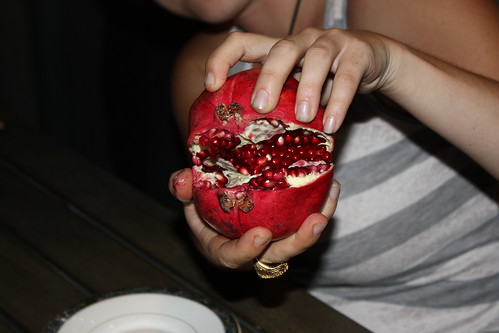
We took the word "syrup" from the Middle East, but for some reason we had to come up with a four-syllable, hard-to-spell name for a fruit that has a perfectly short and useful name ripe for the borrowing. Anyway, Marsha led us through a post-dinner nar appreciation session deftly separating it and passing out segments, which we all plucked out and crunched and savored.

This meal actually took a lot of work to research, since it seems that most of what I can find on the internet is all copies of other recipes and Wikipedia articles. It's a shame, I'm sure there's a lot of diversity and variety in the cuisine that just hasn't made it online yet. But I'm sure glad that at least this much was up there.

And that is it for the A countries! We're on to the Bahamas next.

Week 10: Austria

Laura learned early in our relationship that I'd never seen The Sound of Music. (That's around the same time I learned that she'd never seen Star Wars.) Turns out this musical classic, set in Salzburg, Austria, was the movie of her childhood household, so much so that the two VHSes had worn out. (And now I've seen it, while she still hasn't watched Star Wars. Too bad Tatooine isn't a UN country or that would be a surefire way to obligate her.) Needless to say, with Laura's parents and sister in town, there's no way we could do Austria night without the Von Trapps' dulcet tones.

Now, as far as the food, there were two dishes I found named as Austria's "national dish": tafelspitz and Wiener schnitzel. I put the matter to a vote of our attendees, and they chose the latter, breaded-and-fried veal cutlets, over the boiled beef option. Austrian cuisine, and particular that of Vienna, is best known for its desserts, and while a Sacher torte might have been fun, a strudel just seemed too perfect. (Plus, Fraulein Maria's favorite things include schnitzel and strudel, so there's yet more justification.)

As far as the guests, in addition to Laura's family, we had her sister Jen's friends Leila and Anthony, as well as Kirsty and Barrak. We'd have been remiss to leave out Austria's strong music heritage, so we dined to a playlist representing several genres.

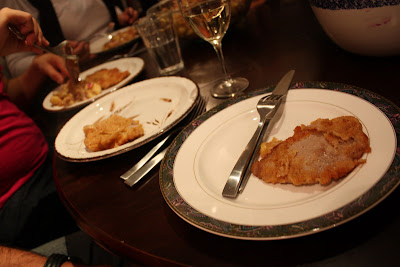
Wiener Schnitzel | Fried veal cutlets | Recipe


Forget the weird hot dog chain of the same name. The real Wiener schnitzel — "Wiener" is an adjectival form of Vienna — is one of those ur-dishes, the granddaddy of milanesas and tonkatsu and all manner of pounded, battered, and  fried pieces of meat. Although most schnitzel these days is made either of pork or chicken, the original is veal. And, apparently, it's traditionally fried in lard. The standard packaged lard is homogenized and pretty gross (just think of what it takes to make animal fat shelf-stable), so I rendered some of my own, and mixed that with butter and oil for a triple-threat of frying goodness. Barrak was on dredging duty, and it turned out just as it should have: crispy on the outside, tender on the inside, and disappeared inside our bellies in just a few minutes.

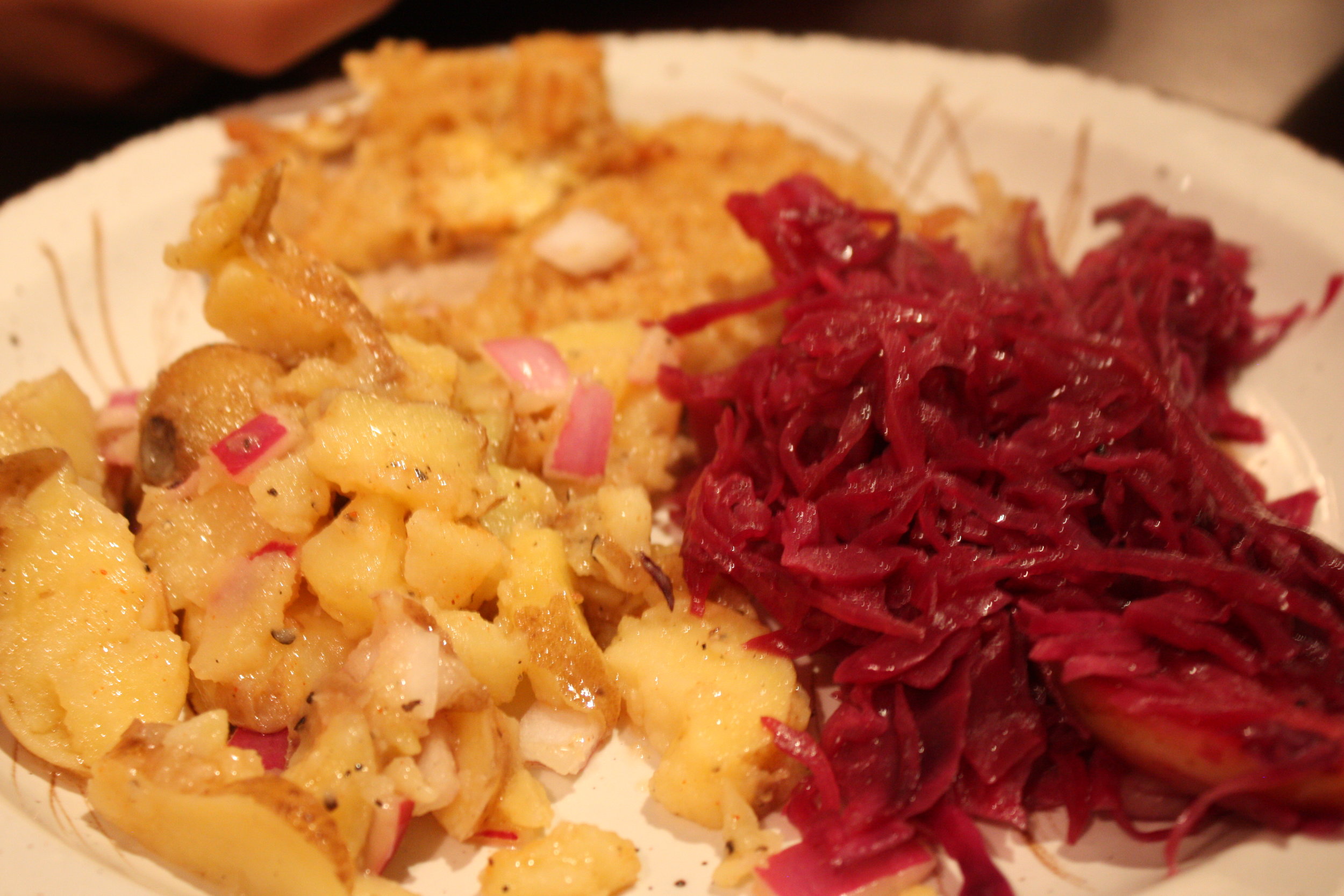
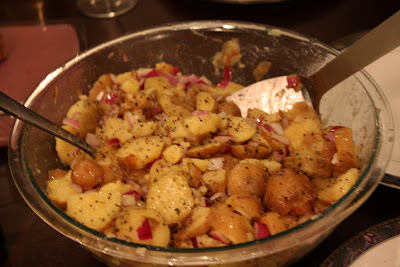
Erdäpfelsalat | Warm potato salad | Recipe (translated from German)

The standard German word for potato is "kartoffel," (apparently derived from the word for truffle) but apparently in Austria it's "erdapfel," meaning earth apple (like the French "pomme de terre"). No matter what they call it, Germanophones do great things with this New World import, especially when it comes to tangy warm salads. When I had it in Germany it usually had little bits of meat; in this recipe, the meatiness comes from the broth. I didn't have beef stock on hand so I used chicken, and it turned out mighty tasty. It probably helped, too, that I used little new potatoes straight from the farmer's market. (If you follow this recipe, you probably won't need as much liquid as it calls for, it would have been swimming in oil and broth had we followed it precisely.)

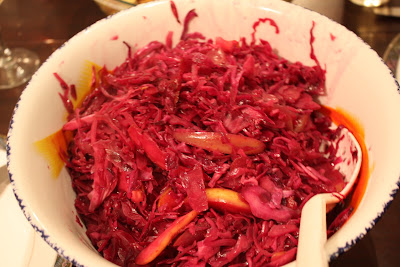
Rotkraut | Red cabbage casserole | Recipe


With apples, orange juice, brown sugar and wine, this was a pretty sweet and pleasant vegetable dish. Also, abundant. Four pounds of cabbage is a ton, and the nine of us barely managed to eat half of it.

Altwiener Apfelstrudel | Viennese apple strudel | Recipe


The recipe cautions to try making a strudel once before you need to serve it. But with 194 dinners, there's no time for practice, we gotta do it live. This was certainly among my more ambitious pastry efforts; indeed, part of my goal with United Noshes was to round out my cooking skills, and this part was sorely lacking. And, might I say, it turned out great. Following the unique technique of rolling, flipping with a cloth, and then stretching by hand, I managed to make a hefty apple-and-breadcrumb burrito out of that thing, with only a little tear on one end that I patched with some leftover dough. (Big thanks to my mother-in-law for all that apple chopping!) It came out beautiful and, yes, it was a crisp appel strudel. To the crowd that was by now watching The Sound of Music after dinner, I hope it was a favorite thing.

Viennese coffee | Recipe

I'm not positive this is an authentic recipe, but it was sure delicious. Anything involving cream, chocolate, coffee and cinnamon is destined for success.

Perhaps aided by the prior consumption of some lovely Austrian wines, the evening devolved (or evolved?) into a good-old sing-a-long. And now we're just one country away from finishing the A's — Azerbaijan is next week.

Week 9: Australia

While Australia is the furthest country in the world from most of the US, my research made it clear that the cuisine there is quite similar to our own — a Western European base with plenty of influences from immigrants around the world. So it took a little asking around to figure out what I could make that would be an only-in-Australia sort of thing. And this is how I learned about the mad genius of the Aussie burger, with a few other gems thrown in.

Tonight was a mini-reunion of Albania, with Snezan, Neely, Rudina, and Kirsty in attendance. We also had the pleasure of the company of Kirsty's mother (all the way from England) and elementary school teacher (all the way from Alabama), as well as Rudina's boyfriend Adam and my friend Mike. Thank goodness the threat of rain never materialized, because between the crowd and the need to grill, doing this one outside was a must.

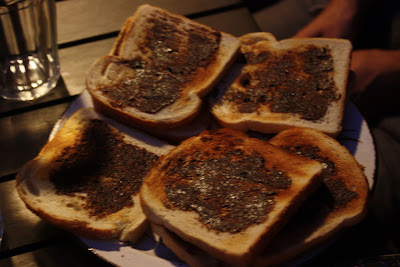
Vegemite on toast

I'd heard plenty about this yeast extract spread that's apparently an immense cultural anchor and source of Australian pride and identity. Well, I found it at Fairway, and we spread it on toast. It was very salty and was like essence of meat in spreadable form. Check that off the foods bucket list.

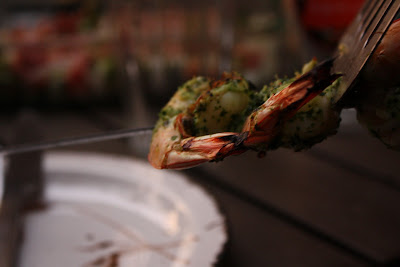
Prawns in coriander-pepper sauce | Recipe


If an American has a thought about Australian food, it's probably "shrimp on the barbie," from a long-running and very successful tourism advertising campaign. It turns out, though, that in Australia they're called prawns, but that's where the inauthenticity ends — barbecuing them is definitely appropriate! I found this recipe, whose marinade is made from the entirely of the coriander (a.k.a. cilantro) plant, including the roots. I used the largest reasonably-priced prawns I could find, and I made sure to get them wild-caught because I've read some awfully nasty things about farmed shrimp/prawns. I had to peel and devein them myself, which wasn't a horrible hassle but probably worth paying a few extra points to avoid next time. Anyway, it was really yummy, a good nibble to pass the time while waiting for the main event.

Beef burger with the lot | "Aussie burger" | Recipes: burger, barbecue sauce


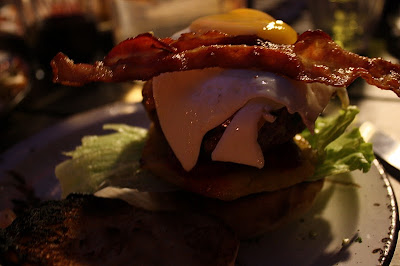
Imagine a hamburger, made with breadcrumbs and some stuff to make it extra juicy. Now imagine it slathered with homemade barbecue sauce, and then stacked with cheddar cheese, a grilled pineapple ring, pickled beets, bacon, and, I kid you not, a fried egg (the recipe above doesn't call for that but I saw several mentions elsewhere). Yes, this was difficult to eat. Yes, this was a bizarre combination of flavors. But gosh, it was good. As Adam observed, the Chinese say that a meal should feature the five major flavors, and, well, this featured them all and then some in one impossible sandwich.

Brussels sprouts with bacon and shallots | Recipe


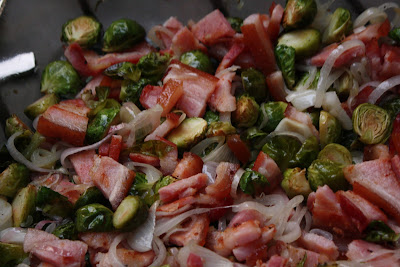
Out of all that comprises "bush tucker," the umbrella term for fruits, vegetables, game and even grubs from the outback, the only native Australian plant-based food that seems to have spread this far is macadamia nut. I made do with a tip from Kirsty that Aussies like brussels sprouts, and I found this nice little recipe on an Australian site, so there we go. Turns out that Fairway has slab bacon that halfway replicates rashers, but I went a bit overboard and got the proportions wrong. This dish ended up a bit more like bacon with a smattering of sprouts. Oops! Well, nobody complained.

Anzac biscuits | Recipe below

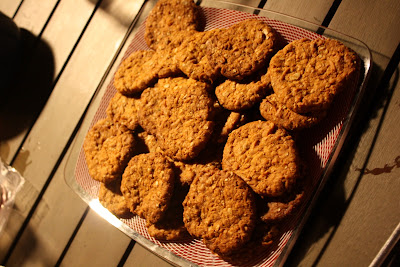
Australia does lay claim to some distinctive desserts. I learned about the meringue-and-cream pavlova, but (sorry Aussies) my research leads me to conclude that it's originally from New Zealand so we'll want to do it then. The chocolate-dipped cake squares known as lamingtons seemed neat too. But Kirsty brought a recipe for Anzac biscuits from her ex's mother, so in the interest of keeping things in the family we went with that. These cookies are named after the Australia and New Zealand Army Corps, the one that met an infamous fate at Gallipoli in World War I. Apparently they were made to last during a long shipment, and to make do during a shortage of eggs, and the oats and coconut hold up valiantly. These disappeared within five minutes of hitting the table, warm from the oven.

As Mike put it, we'd been expecting that this might be a boring meal, but it turned out to defy that expectation. And I'll definitely keep that prawn marinate recipe in mind for future cooking — I could see it going on other types of fish, or even chicken. Next week takes us to Austria, where they don't do shrimps on barbies. Laura's parents and sister will be our guests of honor!


Anzac Biscuits
1 cup of rolled oats
1 cup of plain flour
1 cup of sugar
¾ cup of coconut
2 tablespoons golden syrup (note! this is not corn syrup or molasses or anything else. You can find it British specialty aisles and the like.)
125g (4oz.) butter (one stick)
½ teaspoon of bicarbonate of soda (aka baking soda)
1 tablespoon boiling water

Combine oats, sifted flour, sugar and coconut. Combine butter and golden syrup stir over a gentle heat until melted. Mix bicarb of soda with boiling water, add to melted butter mixture, stir into dry ingredients. If the mixture appears a little dry just add a little more butter or margarine. Place tablespoonfuls of mixture on lightly greased oven trays: allow room for spreading. Cook in slow oven for 20 minutes. Loosen while warm, then cool on trays.

Makes about 35