Meal 76: Iceland

It's kind of astonishing that people have managed to live in Iceland for over a millennium. Trees don't grow there — for hundreds of years they could only make boats of driftwood — let alone much else, so its natural cuisine is quite sparse and based mostly on eating things that can survive on what's around, namely sheep, fish, and whatever random birds can be scrounged up.
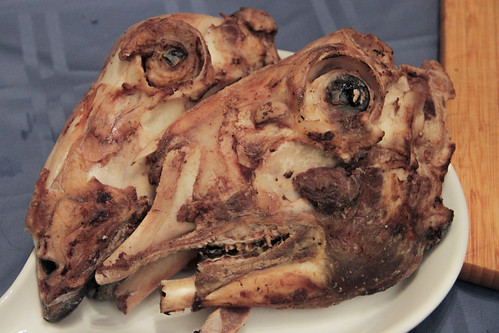
While there's plenty of influence from outside these days, the traditional Nordic month of Þorri (pronounced "thorri"), which starts in late January, emerged several decades ago as the time when Icelanders focus on the most distinctive — some would say grossest — parts of their cuisine in an assortment known as Þorramatur. I elected to forgo such options as rotten shark, fermented ram's testicles, and blood sausage, but I did make two dishes from sheep's heads. Apparently these sorts of food are eaten at this time of year because it's at this point when all the good stuff has ran out, and you're down to the odd parts and long-lasting stuff while waiting for spring.

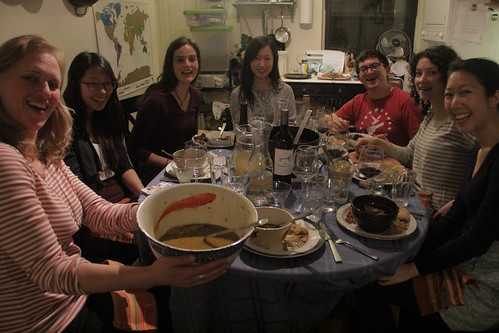
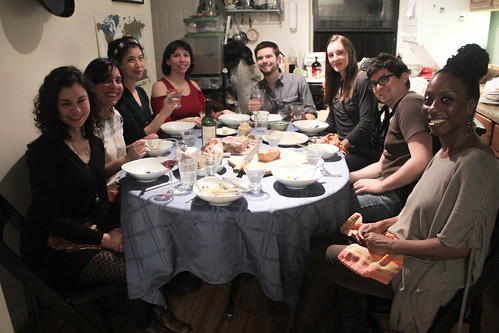
Our adventurous guests for the night were Jessica, Elsa, Chrys, Kate, Dan, Raven, and Cassie.
Áfengi | Drinks | Recipe for brennevín

We needed some liquid courage to steel ourselves for the adventures ahead. The traditional accompaniment to strongly flavored meats is brennevín, which means literally "burnt wine," or brandy, but is more precisely an aquavit. Not having found a local source for the stuff, I found a recipe and took matters into my own hands by infusing potato vodka with caraway seeds and a bit of sugar. After two weeks it turned a rich brown, and tasted quite a lot like taking a shot of a bold Jewish rye!

But then Dan and Raven turned up with a bottle of artisanal Icelandic brennevín that a friend of theirs brought when passing through Reykjavík. This one had about a quarter of the caraway pungency, but also the moderately bitter balancing from angelica seed. More complex and easier drinking, but I'm a bit partial to my punch-in-the-face version!

Iceland also marked the kickoff of Laura's project to come up with cocktails to match each meal. She went with the Midnight Sun, which is made with Icelandic lava-filtered vodka, hearkens to Iceland's traditional flavors with rhubarb, evokes the late-night summer glow with a haunting pale from violet liqueur, and makes it all tasty with blood orange liqueur and lemon. The drink was a hit, nicely balanced, so popular that we went through a whole vodka bottle's worth!

Midnight Sun
Adapted from Creative Culinary
2 oz Reyka vodka
1 oz Rothman & Winter Crème de Violette
1 oz Solerno Blood Orange Liqueur
Half a lemon's juice
Dash of Brooklyn Hemispherical rhubarb bitters

Sviðasulta | Sheep's head cheese | Recipe
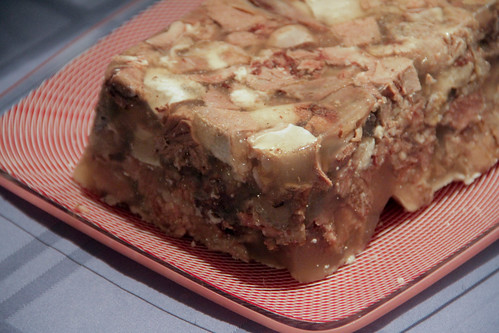
Well, I guess when you're trying to make use of every last bit of the lamb, this is what you do with the heads. (Which, I'll note, I got for the bargain price of $3 apiece, including slicing in half.) I removed the brains, singed the skin over an open flame, boiled the heads for about two hours, and picked off all the meat (which took quite a bit of effort, especially extracting the eyes). The chopped meat, plus some of the boiling water, set in the fridge overnight, and presto! You're the proud owner of a loaf of weird meat parts.

I have to say it tasted better than I expected, and the texture was no worse than I feared, but I can't say I'll be going through all the work to make this sort of thing again.

Rugbrauð | Steamed rye bread | Recipe
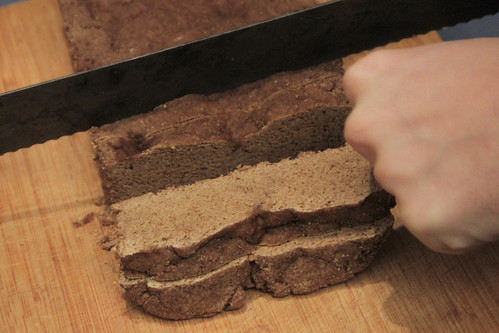
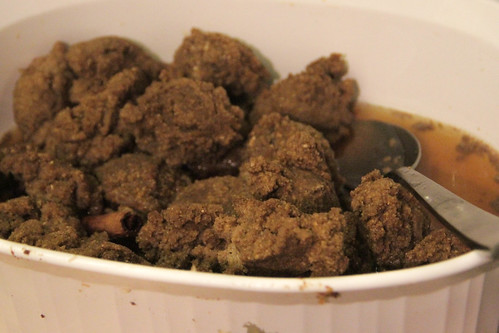
If you live in a land blessed with abundant geothermal energy, why would you bother to turn on an oven when you can instead steam your bread in a hot spring? Alas, I have no volcanic pools at my disposal in Brooklyn, so I used the next best thing: a crock pot. As you might expect, a steamed bread has zero crust and is pretty dense, but this sweet, moist, richly flavored loaf was a good balance to the head cheese, especially with a smear of butter!

Flatkaka | Rye flatbread | Recipe
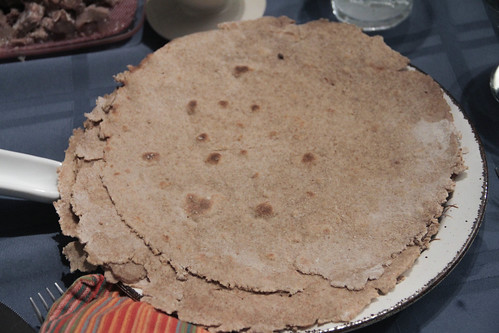
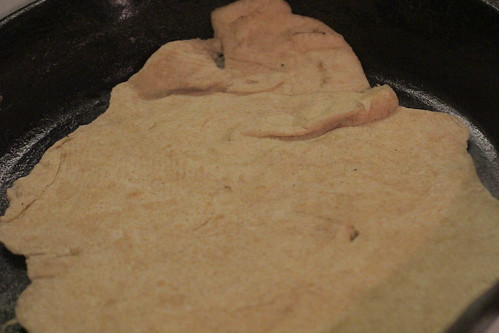
These look and taste surprisingly similar to Indian chapati. The idea's basically the same: an unsweetened, unyeasted dough mixed with water, rolled out like tortillas, and toasted on high heat with no oil. These do have a smidge of baking powder which makes them a tad cracker-like when they come off the pan, but a sprinkling of water and a rest under a damp towel keeps them soft. (The recipe says to "dip in water," but I think that's a concept that might have been a bit lost in translation. Think anointing, not baptizing.) They bread is fairly bland but with that characteristic nuttiness of rye, and is a nice way to sop up some soup.

Kjötsúpa | Lamb soup | Recipe
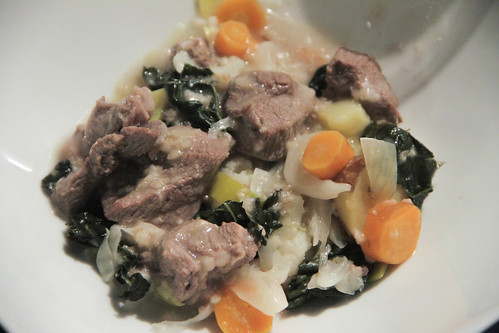
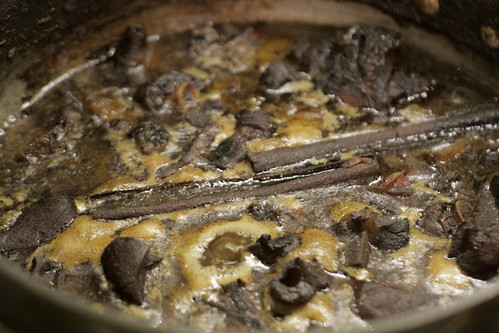
This was supposed to be a roast leg of lamb, but as I went to add a cup of liquid to the dish in the oven, I forgot the one inviolable rule of using glass bakeware: no sudden temperature changes. With a shattered casserole and shards of glass all over the oven, it was time to find inspiration in the Icelandic tradition of resourcefulness, and make do as I could. I slices off all the exposed surfaces of the leg lest there be any glass embedded, chopped the rest into pieces, and threw together what turned out to be a quite decent, if unexcitingly flavored, lamb stew. The texture was a bit interesting, with the novel addition of rolled oats to thicken it up and add some body.

Fiskibollur | Fishcakes | Recipe below
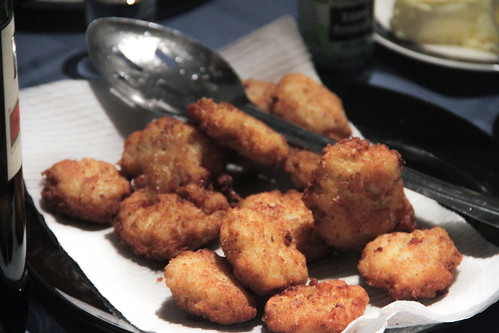
The waters around Iceland teem with fish, and the Icelandic culinary repertoire has figured out just about everything to do with it, from broiling to pickling to letting it dry on a stick in the wind and the sun for several weeks. But the recipe I saw most frequently was for balls or cakes, ground up and made into a batter, then fried. The most reasonable fish at the farmer's market was hake, which I passed through the meat grinder and made into a pasty mush with various liquids and starches. They took longer to fry up than I expected, but the result was quite nice, like a really fresh and tasty and fluffy version of Gorton's fishsticks

adapted from The Icelandic Cookbook by Hulta Emilsdóttir

2 pounds firm, white-fleshed fish fillets. I used hake; cod would be maybe even more appropriate. Pieces or scraps are OK. 1/2 small onion, chopped 1/8 teaspoon ground nutmeg 1/2 teaspoon pepper 2 teaspoons salt 2 eggs 1/2 cup milk (I ran out of milk, so I used a splash of cream plus some water) 1/4 cup flour 2 tablespoons cornstarch oil for frying (I used corn oil, plus some tallow that I rendered from extra fat from the lamb)

Start heating the frying oil. Put fish, onion, and spices in a food processor and grind, or for a fluffier texture do as I did and put through a meat grinder. Add eggs and milk, then flour and cornstarch, mixing with your hands. When the oil's good and hot (test with a little fleck of the fish batter), form into cakes (I essentially made a ball in my hands and flattened it a bit) and fry until golden brown on each side, maybe 15-20 minutes total.


Brúnaðar kartöflur Caramelized potatoes | Recipe at end of post
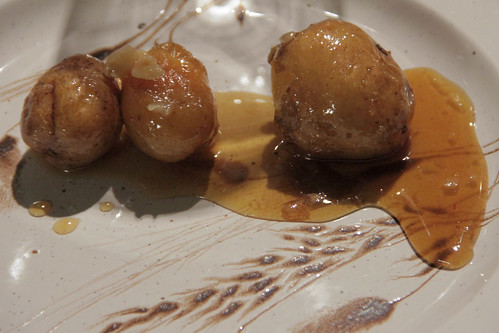
adapted from The Icelandic Cookbook by Hulta Emilsdóttir

2 lbs potatoes. Best is small new potatoes; if they're medium or big, cut them up. 1 cup sugar 1 tablespoon water

Boil potatoes, drain, and put back into the warm pot. Put sugar in a frying pan big enough for all the potatoes (but don't add potatoes yet). Heat on high, and using a heat-resistant rubber spatula, stir constantly. It will seem like it's not doing anything, then cluster up into chunks and brown a bit, and then liquify. When it liquifies, remove from heat and carefully add a few drops of water at a time while constantly stirring. Don't add more than a few drops at a time, and don't forget to stir, otherwise it'll chunk up again. Put potatoes in, toss to coat, and keep warm until serving. If at any point the sugar re-hardens, just heat and stir.

Pönnukökur | Fluffy crêpes (or thin pancakes)
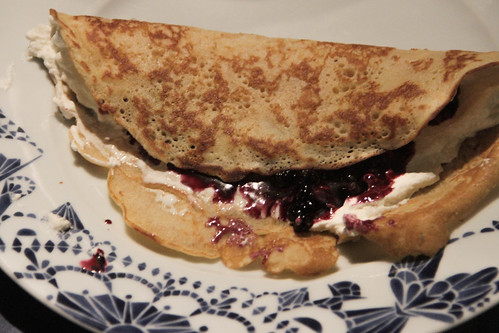
adapted from The Icelandic Cookbook by Hulta Emilsdóttir

3 tablespoons butter, plus more for frying pancakes 3 eggs, separated 3 cups flour 1/2 cup sugar 1/2 teaspoon baking powder 1/2 teaspoon baking soda 1 teaspoon vanilla extract 2-1/2 to 3 cups milk whipped cream jam (I simmered a bag of frozen blueberries with some sugar)

Melt butter in a crêpe pan (or a frying pan if that's all you've got) and let cool slightly. In the meanwhile, whip the egg whites. In a separate bowl, perhaps a 2-quart measuring cup with a spout, combine the dry ingredients, then add the butter and enough milk to make the batter fairly runny, like a crepe batter. As you reheat the pan, fold the egg whites into the batter. Once the pan is good and hot, pour about a quarter cup of batter into the pan, and swirl around to cover, pouring any excess back into the batter. Put whipped cream and jam inside of the pancake, fold up, and devour. Note that the pancakes can be successfully made in advance and reheated in the microwave before serving.

The playlist for the meal was surprisingly familiar. Betwen Björk, Sigur Rós, and Of Monsters and Men, this Virginia-sized island with a population smaller than Anaheim has made an outsized dent on the American music scene!
Meal 75: Honduras + Holy See

Our first, and only, two-state meal! Here's why: the Holy See, as the "legal personality" of the Vatican City, is one of two non-member permanent observing states at the UN. The other, Palestine, has a cuisine well worth exploring, but setting aside quips about wine and wafers, there's nothing distinctive about Vatican cuisine, at least compared to the city of Rome that surrounds it. That said, the next UN country alphabetically happens to be a Catholic one — Honduras — and it was December, so it just made sense to do a Christmas party combining this Central American country's traditions with a few splashes of Roman cuisine. Thanks to the more than two dozen friends who stopped by and enjoyed this hybrid meal, along with random drinks left over from previous meals!

As in many Christian countries, there are ritual foods for this holiday. Without a doubt, tamales are on the top of the list — if a family makes tamales but once a year, it'll be for Christmas. Never mind that I'd made tamales recently for Guatemala, I just couldn't do a Honduran holiday meal without them. At least it's an opportunity to compare, right? Along with the tamales, I made roast pork and tried and failed at a dessert. I made up for the apparent lack of vegetables with an artichoke antipasto, and thankfully I made an  Italian dessert that actually worked.

Carciofi alla romana | Artichokes with mint and parsley | Recipe

There's an herb that apparently grows in Lazio, the region Rome and the Vatican are in, called mentuccia, which they say tastes somewhere between mint and parsley, so that's substitution #1. And artichokes aren't in season, are really expensive, and aren't all that tasty this time of year, and plus it's tough to find true Roman-style artichokes, so I used hearts from a can, substitution #2. It didn't look fanstastic, but you know what, this darn thing was tasty. I mean, probably anything braised with those two herbs plus a generous dousing of olive oil and a little wine added for braising would. Maybe I'll try this someday with frozen artichoke hearts, or even an entirely different vegetable like artichoke.

Tamales | Recipe (scroll down for English)

output_5KUTsq

Compared to the Guatemalan tamales two months prior, I had an easier time making these. In large part it's because the recipe I followed is less fussy, no pre-roasting all the vegetables, no complicated seed-based sauce. But with the benefit of experience, I didn't concern myself with making perfect squares out of the banana leaves, and I was fearless with adding copious amounts of fat to the masa.

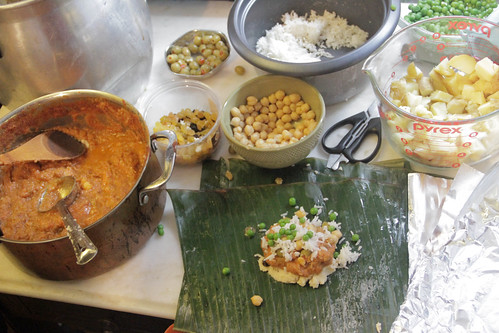
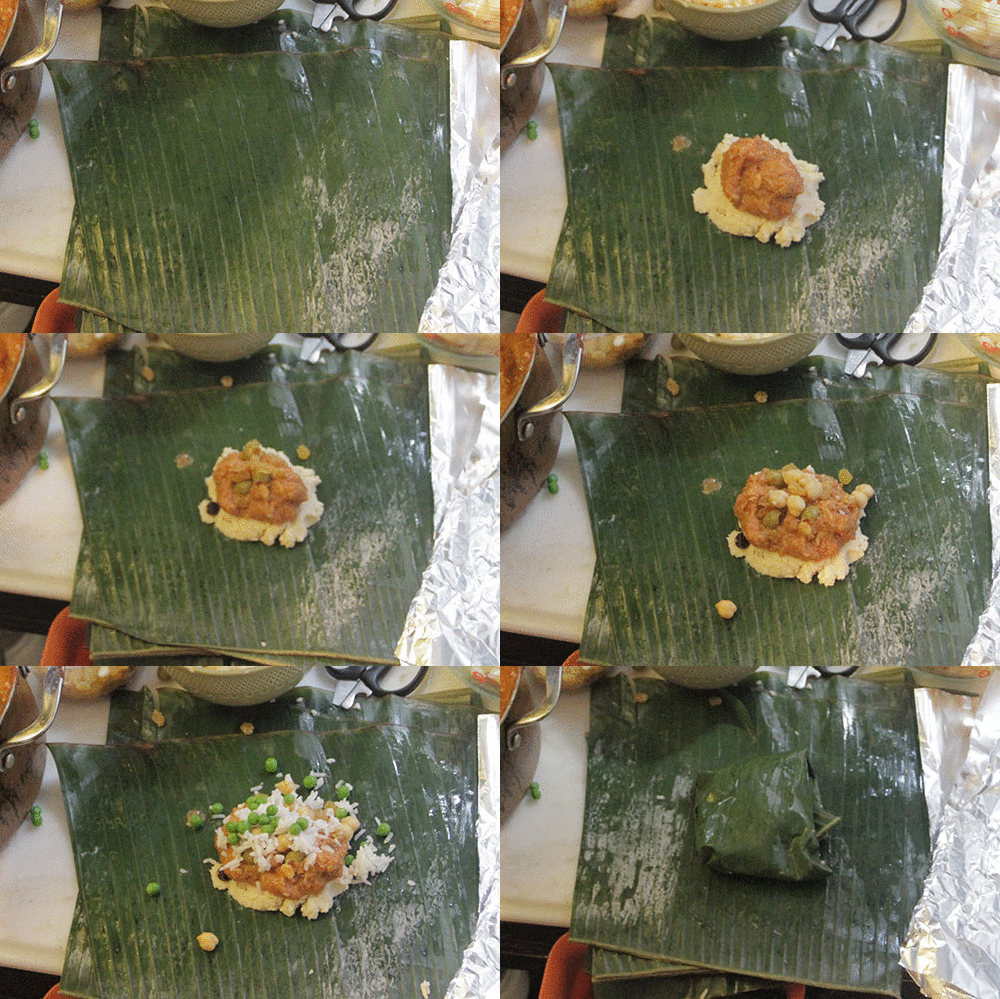
As the animated image shows, there's a wide variety of ingredients in a Honduran tamale! In order, it's: a banana-leaf wrapper, lard-laden cooked corn mass, pork in a vegetable sauce colored with annatto, pimiento-stuffed olives, raisins, canned chickpeas, rice, green peas, and potatoes, wrapped up and ready for steaming. (I found the recipe ended up with way too much masa, but not enough raisins or chickpeas, relative to the pork sauce. Your results may vary.)

After an hour and a half of steaming, the textures become a gradient of mushiness, but individual nuggets retain their flavor: a briney olive, a bright burst from a pea, an incongruous bolt of sweet from a raisin. They were really convenient for the ongoing meal service of the party, as being kept warm for a few hours didn't have any adverse affect.

Pierna de cerdo al horno | Roasted pork leg | Recipe (scroll down for English)

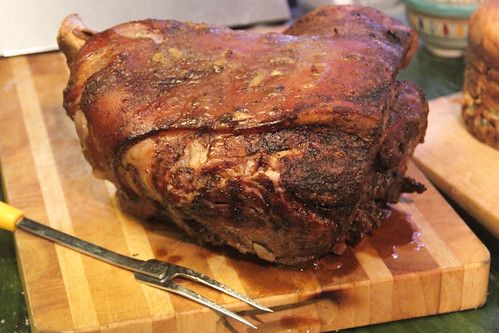
Multiple expat blogs complain that cumin is about the only commonly used spice in Honduras. I can see how that would get old, but my, this was tasty. Poke the big hunk of meat all over (I used a shoulder butt partly because I find that a hilarious term that sounds like faux anatomy, and also because I couldn't easily find a whole pork leg), insert slivers of garlic, and bathe with a cumin-wine mix overnight. Bake it low and slow, uncover and spray with water at the end to crisp up the skin, and enjoy. This whole thing was just about entirely gobbled up by the end of the evening.

Panettone | Sweet yeast bread with fruit | Recipe

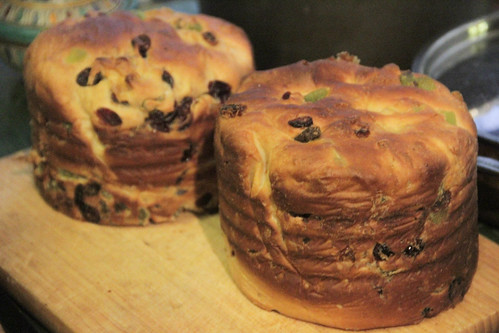
There's a deep tradition of sweet cakes around Christmastime in Italy, panettone being perhaps the most famous. I'm always a fan of using unorthodox techniques and equipment to achieve results, so I was tickled to learn that instead of buying a tall, round panettone mold, I could easily use a parchment-paper-lined industrial-sized can. Chef Joe at work hooked me up with a few sparkling-clean #10-size cans that once held grape jelly, and I got to work.

I was a bit hesitant to try this recipe given the mixed reviews, but I'm glad I did. They key seems to be giving the yeast enough time to do its thing. Compared to a standard packaged panettone, this one as lighter and fluffier, quite reminiscent of a brioche. A dash of King Arthur Flour's shockingly pungent Fiori di Sicilia extract gave a lovely aroma of orange. And since I chose the fruits that went into it (raisins, apricots, and candied kiwis!), I enjoyed them. Best of all, panettone preserves and ships well, report my parents after receiving the extra!

Torrejas | Fried syrup-soaked dough | Recipe (not that it worked for me!)

Well, this one was a dud. What I'd heard discussed as being the Honduran equivalent of French toast ended up looking and tasting really dull and unappetizing. Part of the challenge was recreating pinol, which I understand to be a sort of chocolate and cornflour blend, but I probably estimated the proportions wrong. Also, it was supposed to end up flat like slices of bread but took on the shape of uneven meatballs. And the sweet, cinnamon-seasoned syrup didn't really penetrate, so the whole thing was, frankly, gross. Oh well, at least we had panettone!

Meal 74: Hungary

Though it's common to think of Europe as being a jigsaw puzzle of peoples who've been there since before recorded history, the people who now populate the land known as Hungary didn't show up until a mere millennium ago. Known as the Magyars, they brought a herding tradition — and a non-Indo-European language most closely related to Finnish — from Siberia. Over the centuries, they settled into an intensely agricultural society that blended new foods such as paprika from the Turks and pastry from the Austrians into their meaty, brothy, bready core cuisine. (And oh, do they like their paprika: I used a quarter-pound in making this meal! If you're cooking Hungarian food, do yourself a favor and get some fresh stuff.) Related to jigsaws, one thing I've been mulling about after cooking this meal is that the old phrase, "The whole is greater than the sum of the parts," isn't always true. In fact, often you can get more utility out of breaking up an ingredient, and using each bit to its advantage. With the chicken, I was able to get several tablespoons of fat by trimming off the skin and slowly rendering it. (I used this in place of lard. No objection to lard, I'd just forgotten to buy some, and it was cold out!) And with the eggs in the torte, by separating the yolks from the whites, the recipe avails itself of the richness and emulsifying properties of the former, and the magical leavening properties of beating the former.

We were lucky to have two people of Hungarian descent, Michele and Danielle, with us. (I'm one-eighth Hungarian, for what it's worth!) Also on hand were Brandon, Diana, Irene, and Soo-Young who's in Budapest as I write this!

Gulyás | Beef and vegetable soup with paprika | Recipe

This dish, called "goulash" in English, was originally made by herdsmen, who'd slaughter one animal, make a huge stew in a hanging pot over a fire, and eat for several days. Accordingly, it's an unfussy dish, and while you'll see a whole lot of recipes out there, it's little more than cubes of meat slowly cooked in a broth scented with paprika and onions with some root vegetables thrown in toward the end. (The farmer's market happened to have parsley root; if you can't find that then parsnips are a good substitute.) I do particularly like this recipe for its caraway seeds, which add an almost minty aroma and play nicely off the brightness of the paprika.

Csirke paprikás | Chicken in paprika-sour cream sauce | Recipe

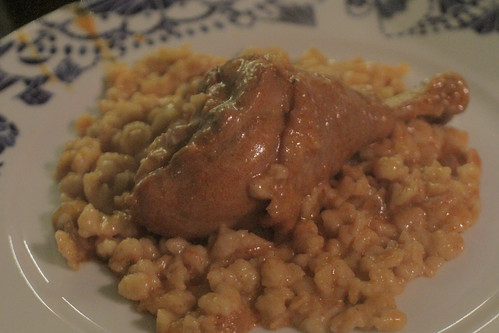
I loved this dish growing up. The vibrant color and flavor of the paprika, with the scrumptious creaminess of the sour cream, made for an unctuous sauce to smother over every bit of chicken and sop up with noodles. In my preparation, I took it two steps forward and one step back. The mistake was accidentally buying a hen instead of a chicken, which even after an hour and a half of braising was still pretty tough. The two things I did right: using super-thick, homemade sour cream, known as tejföl in Hungarian and known throughout Slavic countries as kajmak; and making spätzle-esque dumplings to sop up all that tasty sauce.

Nokedli | Little egg dumplings | Recipe

These dumplings are not at all complicated to make, it's just tedious them. Mixing up the dough takes all of two minutes, but scraping the dough back and forth across a spätzle plane over boiling water, and then scooping the little boiled dough bits, takes patience. They did go absolutely perfectly with the cream sauce, so I don't at all regret making them, and I'm happy I happened to have the proper device on hand. (If you don't have one, you can pinch off little bits of dough, but the texture wouldn't be the same and it'd be even more annoying to make!)

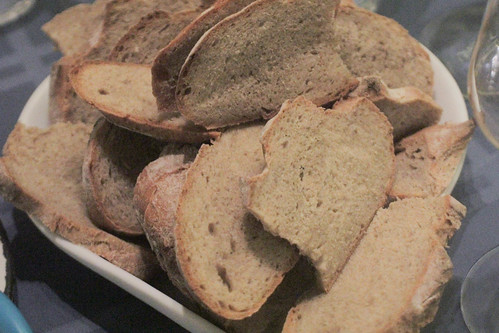
Kenyér | Crusty bread | Recipe

Just as no battle plan survives contact with the enemy, sometimes what I figure out to cook makes no sense once I start getting down to it. I'd identified a Hungarian bread recipe, but as I set out to start making it I realized it was of the sweet variety, nothing like the hearty, crusty bread that the above dishes require. So with several hours remaining until meal-time, I researched more deeply, only to discover that the best recipes require overnight fermentation. Drat! Well, I happened to find a website in Hungarian that through Google Translate seemed to approve of this no-knead recipe, with hints of rye and whole wheat, so I went for it.

I'd kind of looked down on no-knead breads — how would you develop the gluten? why are you afraid of touching the dough? — but you know what, for a fraction of the work and no additional time, this was one extremely decent loaf. The crust was decently thick and crunchy, the interior spongy and dense but not gummy. Really, an excellent bread for sopping up soup and sauce without falling apart. I think I'll make it again.

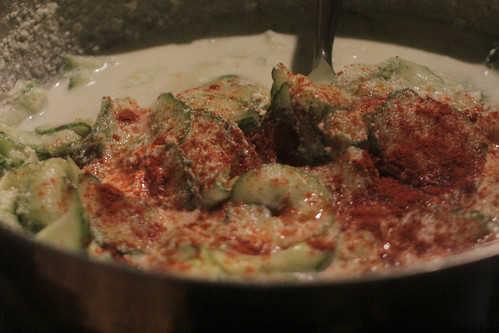
Uborka saláta | Cucumber salad | Recipe

As one description says, "Hungarian vegetables tend to be of the nongreen variety." Cucumbers make a notable exception, perhaps because of the crisp and cool contrast they make to the rich, soft stewed meats. This salad wasn't all that exciting, and I think I put too much water in the dressing so it was all just not very flavorful, and yet it took a lot of work to shave the cucumbers — since I don't have a mandoline, and I wanted thin uniform slices, I used a peeler instead.

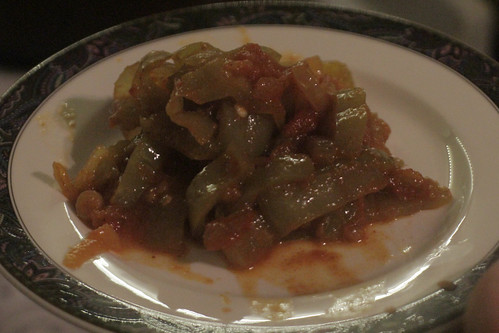
Lecso | Stew of peppers, tomatoes and onions | Recipe

I probably didn't need to make this since there was so much other food going on, but it wasn't too hard. As another simmered dish, the texture matched that of the stews. The recipe mentions that it makes a good breakfast with some eggs on top, which sounds pretty similar to shakshuka, the North African dish.

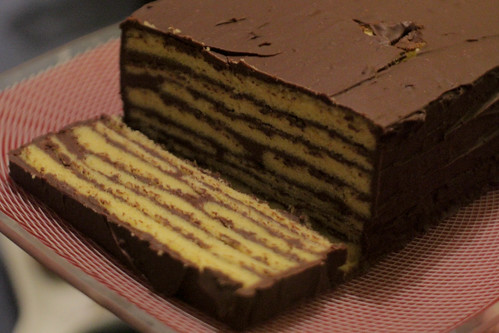
Dobos torta | Chocolate-frosted layer cake | Recipe

I'm not huge on pâtisserie. The precise chemistry of baked goods is too much science and not enough art, while I'm a bit too haphazard to carefully handle and prepare fragile goods in precise preparations. But I had to game up for Hungary, which thanks to its split empire with Austria gained a strong expertise in making really tasty and impressively composed desserts. And all signs pointed to making this multi-layered cake, slathered with a thick coating of bar chocolate and butter to allow for long storage and transportation. (And flavor!)

The classic dobos torte is round, with a toffee crust. The cake part is little more than an really sweet omelet, with ten egg yolks, a pound of sugar, seven beaten egg whites, and less than a cup of sugar. Despite appearances, you don't cook one cake and then slice it like cheese, rather you bake the layers on their own. It's really tedious to bake each layer individually as would be required for a round cake, so I followed the Smitten Kitchen advice and simply made two jelly roll pans of cake and sliced them up. No good excuse on not having the toffee crust; I just messed that one up by being too cautious and removing the caramel from the stove before it was done, so I ruined one layer of cake and just junked it. But other than that, this cake was pretty easy, the frosting is especially forgiving and after refrigeration sets very nicely.

This was our last sit-down Nosh of the year. We've got a combined Honduras/Holy See holiday party coming up, and then in the new year we're onto the I countries!

Meal 73: Guyana

It's considered Caribbean, though it's on the South American continent. It was first colonized by the Dutch, gained its independence from England, has a notable native population, yet the two largest populations are of (East) Indian and African descent. No doubt, Guyana — pronounced like the first names Guy and Anna together — is quite the blend of cultures, a study in miniature (the population's under one million) of many of the influences of the colonial age on the Americas. And as we've seen time and again, where cultures collide, so do their foods, so it's no surprise that Guyanese food has an intense Indian influence.

Joining us for this week's adventure: Rachel, Eunice, Sarah-Doe, Xindi, Erin, and Valerie! (Also, notice how we've finally put up our scratch-up map in our no-longer-very-new place.)

Limewash | Recipe

It's essentially the lime equivalent of a lemonade, but with small and awesome improvement: a splash of vanilla! That little bit of depth and perfume takes a bit of the edge off the sourness, while also complementing the floral notes of the lime. I also got a bit more depth by using demerara sugar — named after a former Dutch colony that's now part of present-day Guyana — which is a crystallized brown sugar, meaning it's got much of the minerally and tasty molasses from the cane. (You could use the similar, but more finely-grained, turbinado or "sugar in the raw" instead with the same result.) Goes great on its own, or with rum!

Tamarind balls | Recipe

The word tamarind comes from the Arabic tamr hindi, meaning "date of India." They are indeed somewhat like dates in that they're a dark, rich, pitted fruit that grows on a tree and can last a good long while. But tamarind is a whole lot more tart. Sometimes it's used as a savory ingredient, such as in pad thai, and often it's sweetened up, when it's served as a juice. This recipe splits the difference, mixing a in whole lot of sugar (again I used demerara) but also raw garlic and chili, making for a puckery, sweet, intense flavor explosion. It's hard to eat too much of this at once, but even a small bite makes your mouth water, so it's an ideal amuse-bouche.

Fry channa | Crispy chickpeas | Recipe

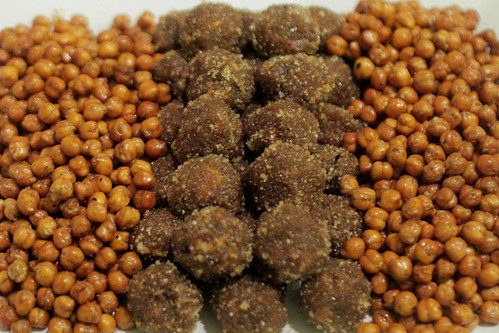
After fry-tastic Haiti, I wasn't up for plunging more things in hot oil this week, and accordingly we missed out on a wide variety of Guyanese treats, notably a split-pea fritter called pholourie. While there's no way to fake a fritter, fortunately one of the several bloggers offers a fantastic substitute for another dish, fried chickpeas. It's really extremely simple, you just soak them overnight, drain and dry them, add a few spices and a tad of oil, and bake until crispy. In color and crunchiness, they're more than a little reminiscent of CornNuts — these aren't a snack to take along when you need to silently munch. But for a super-healthy and cheap snack that keeps quite a while and is a great pairing for beer or a cocktail, I'd recommend this.

Hassar curry | Recipe

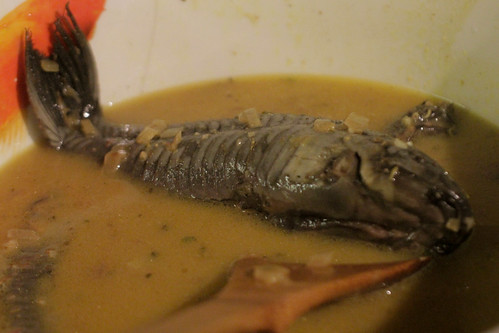
This dish is a perfect example of the blending of East Indian cooking techniques with West Indian ingredients. In this case, it's a coconut milk curry made with a respectable blend of spices you'd find in any respectable kitchen in the Subcontinent — turmeric, coriander, fenugreek, cinnamon, etc. — but the fish you'll find swimming in it is a novel one. The hassar is a catfish with an articulated shell, or what this recipe describes as an "underwater armadillo." If you don't live near a Guyanese or Trinidadian market you just won't find this fish, and while you could substitute with a catfish or tilapia, really so much of the wonder of this dish is the strangeness of the shell. The flesh itself is firmer than you'd expect for a medium-small fish, and pretty tasty although it likes to cling to the bone so it's a bit inconvenient. If you do find the fish, keep in mind that it's best served whole to each diner so they can attack it as they please, rather than trying to shell the fish before serving. Oh, also, serve it with rice to sop up all that curry; roti, as I tried, just didn't do the trick.

Pepperpot | Recipe

There are endless variations on Guyana's national dish — onions or no? one kind of meat, or a variety? is chicken reasonable or sacrilege? — the one point in common is cassareep. The product is as exotic as the name: extract of cassava, boiled with spices until it's turned thicker than molasses and about the same flavor as steak sauce, that somehow acts as a preservative that allows meat to stay for long periods at room temperature. If you can't find cassareep, then you can't make a Guyanese pepperpot. (If you can find cassava, you can make cassareep yourself, but I'll leave that as an exercise to the reader. Even I, an avid make-it-from-scratcher, bought this pre-made, as do most Guyanese.)

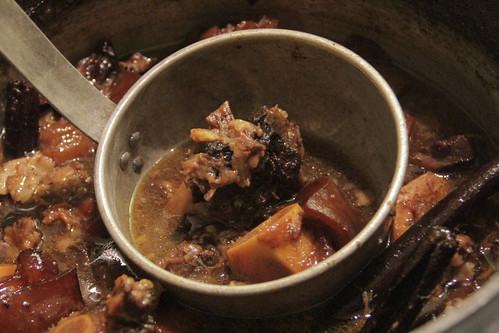
For meat, I went with ox tail, lamp chops, and cow feet, all cut into chunks. The recipe I followed is a more basic pepperpot, with little more than meat, spices, and cassareep. (I got the idea for pre-simmered cow feet, as well as to brown the meat, from another recipe, but that one called for onion and thyme and all sorts of fussier stuff.) I cooked it for maybe 3 or 4 hours on a low simmer the night before, left it out on the stove overnight, and re-simmered for about two hours before serving. The result was a rich, semi-sweet stew loaded with umami, that "sixth flavor" evoking protein-y meatiness. Not surprisingly, after all that cooking, the meat totally fell off the bone. I really enjoyed the flavor and texture, but due to the intensity I can't see myself craving this more than once ever few years.

Roti | Flaky flatbread | Recipe

What the Guyanese call roti would be recognizable to a modern-day Indian as a paratha, made of a bunch of flaky layers, kind of like the croissant of flatbreads. The technique actually isn't as hard as I'd feared; it's worth scrubbing through the video in the recipe to see the hardest-to-describe part of the technique, where you take rolled-out dough, generously butter it, cut a line from the center to the edge, and then roll it up into a big cone before stuffing in the ends. Then, when you roll it out again, that's how you get all those layers. So clever.

Two things I did wrong. One, I used whole-wheat flour for half of this recipe. I went with that variation because the item that's called roti in India is made more often than not with whole wheat, but I think that both in terms of flavor and texture it didn't work, tasting kind of flat and not being flaky enough. The other was that neither of the dishes I made are actually made to go with roti — curry goes with rice and a pepperpot is traditionally served with a challah-like braided bread. Oh well, it was still fun to make!

Mango achar | Green mango pickle | Recipe

This is an all-purpose accompaniment to add tartness and spice to any dish. I went through all the motions, but just didn't start it early enough. It tasted too strongly of mustard oil and the spices hadn't yet pervaded, so if you feel the urge to make this, definitely give yourself a few days' head start.

Parsad | Milk and wheat dessert | Recipe

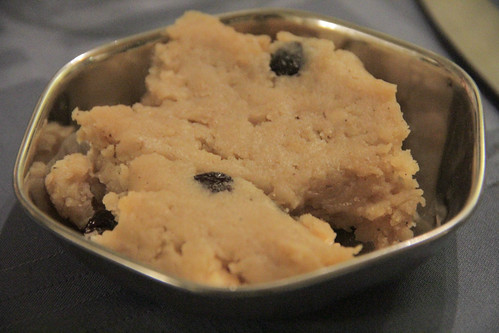
This name is slight variation on prasad, a Hindi word referring to food that is first offered in a religious ceremony and then eaten by people. In Guyana the term has been more narrowly applied to a specific dish of a sweetened and spiced milk and wheat porridge, kind of like a more aromatic cream of wheat. After the intensity of the flavors of the meal, this mild and soothing dish made for a satisfying conclusion.

Meal 72: Haiti

Have you ever pondered what would have happened if something went differently at a given point in history? Compared with the rest of the Western Hemisphere, Haiti is sort of a real-life example of contrarian history. The crux is a slave revolt against French colonial masters that, incredibly, led to independence in 1804. The slave system was ruthless and required a constant influx of slaves, which had the silver-lining consequence of a strong syncretic culture quickly developing that combined French and West African influences — ranging from language (Kreyol is mostly French vocabulary but has strong West African grammatical influence) to cuisine to religion.

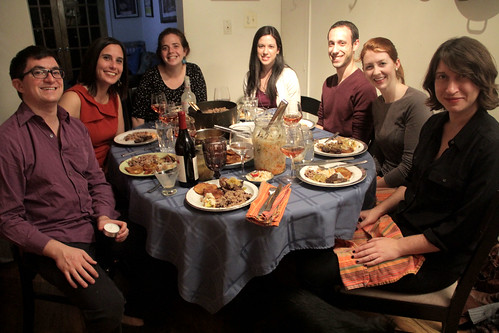
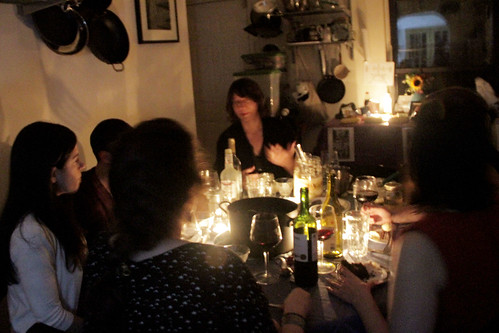
Our meal fell directly on fet gede, a Vodou celebration blending the Catholic traditions of All Souls' Day with West African-derived spirits and beliefs. To get into the mood, we made an altar with some of the traditional elements, including an offering of our own ancestors' favorite foods. The meal, while not unique to this holiday, is one that would be appropriate to the festivities, particularly because the spirits related to death love spicy food. To bring a little bit more of Port-au-Prince to Brooklyn, we turned out the lights and ate by candle, since most folks only get electricity a few hours a day, if any.

Joining us for this adventure were Lisa, Alex, Samantha, Johan, CJ, and Rachel. Alex spent a month in Haiti, whereas CJ recently lived there for a year.

Kremas | Rum cream | Recipe

The drink par excellence for fet gede is pikan, hard liquor steeped with scotch bonnets. CJ brought some that she'd made for last year's, so you can imagine how pungent it was — all you need is the tiniest sip of this truly firey water.

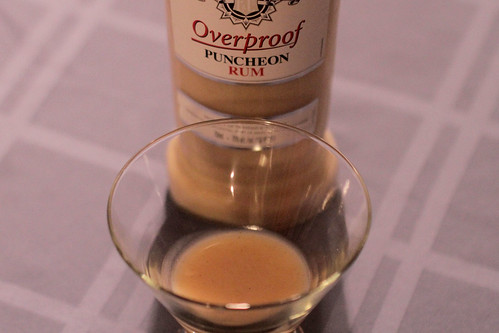
For the rest of our Haitian-style drinking, we drank this cordial that's pretty much the opposite — an unctuous, sweet, spiced blend — with the only part in common is the alcoholic strength, thanks to being made with overproof rum. Between the spices (cinnamon, ginger, nutmeg) and the thickness of the liquids (condensed milk, evaporated milk, cream of coconut), this drink was quite reminiscent of eggnog, just a whole lot stronger. While all enjoyed the flavor, some found the thickness too heavy to indulge in more than a glass, but I quite happily managed to have several.

If you choose to follow this recipe, just note two things: you should use more than a quarter-cup of water to make the simple syrup, and this made two liters in total (and I only used a 750 ml bottle of rum, rather than 1L), so be prepared to give plenty of it away. Oh, and it's extremely important to look people in the eye when toasting. Goodness knows you don't want to get on the wrong side of the spirits.

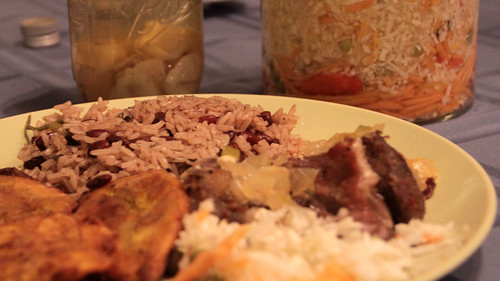
Pikliz | Spicy pickled slaw | Recipe

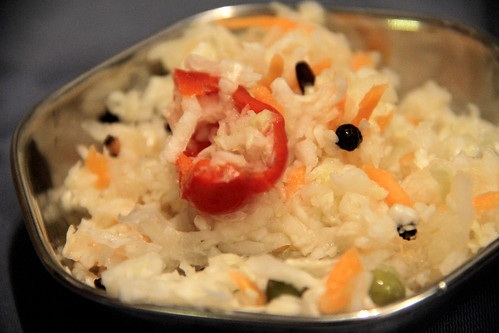
Growing up in California, taquerias were a core part of my childhood, and at some point my dad taught me the awesome trick of picking out the carrots from amongst the pickled japaleños at the salsa bar, to get the spice infused from the surrounding peppers while also getting more of the vinegar flavor. I feel like pikliz takes this concept to a marvelous extreme, with just a few extremely hot scotch bonnet peppers seasoning a whole jar of shredded cabbage, carrots, and whatever other veggies you throw in, by bathing together in spiced vinegar. And then there's whole cloves thrown in there to add a little more exotic flavor. I threw all the vegetables through the Cuisinart's shredding disc, but next time I would probably use the thin slicer for the cabbage to keep it in larger pieces.

Pikliz is such an essential part of the cuisine that everyone who'd been to Haiti whom I told about this meal asked if I'd be making it, and there's even an expat website called Pikliz.com. So, if you're doing a Haitian meal, don't leave this out, and be sure to start this a few days in advance to let that spice from the peppers migrate over to the vegetables! And then throw it on just about everything, as there's little on the Haitian table that won't go well with some vinegary crunch-n-spice.

Tasso cabrit | Fried goat | Recipe

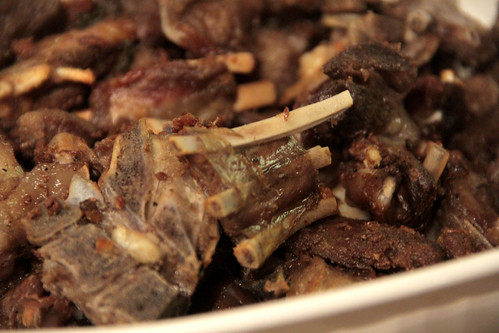
This was, hands down, the tastiest goat I've eaten in my life. What it's lacking in visual appeal, it way more than makes up in flavor and texture.

It started with a trip to the Fertile Crescent, where the butcher cut stew pieces of meat to order, including the super-tasty rib bits. Then to Bed-Stuy where I had to pop into a few markets to find the elusive sour orange, a green fruit with thick skin, a ton of square-ish seeds, and appropriately named flavor that's just excellent as a marinade. The night before the meal, I squeezed up the oranges, mixed with a bunch of other ingredients including lime, ground clove (there's that spice again!), hot peppers, etc.

Some recipes call for a simple vinegar marinade and then boiling with all the flavors; other call for a rich marinade and then a simple boil. I find it hard to let go of good flavors once you've got 'em, so the next afternoon I dumped the whole bowl, meat and marinade alike, into a pot, added water to cover, and then let that simmer for a good two hours or so. The recipes say to boil, but tough meat always enjoys slow heat, and my tweaks were vindicated by a really tasty and tender meat.

But wait, there's more! Once I finished frying up the plantains, I turned up the heat and threw the goat in the same oil, adding a lovely crisp to all the edges. Once served, these tasty chunks lasted approximately five minutes on the table. The only challenge was successfully navigating all the bones by candlelight!

Sauce Ti-Malice | Tomato and onion sauce | Recipe

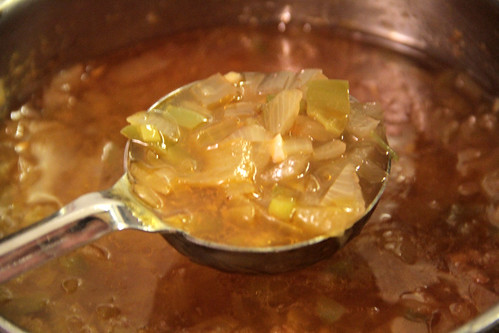
This sauce is pretty much soupy sautéed onions with hints of other ingredients. I saw it mentioned on pretty much every site I visited, but I'm not sure I get it. The rest of the cuisine has such vibrant flavors and textures, while this came across as kinda bland and watery. Did I do something wrong?4

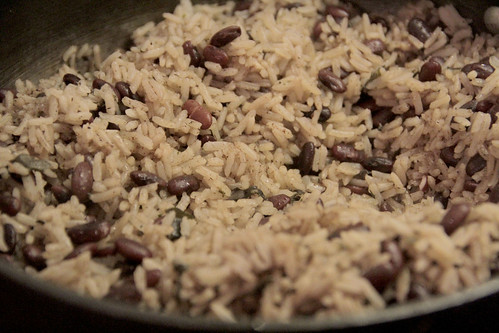
Diri ak pwa | Rice and beans | Recipe

Doesn't that look like an exotic, perhaps African, name for this dish? Actually, it's the Kreyol transformation du riz au pois. Highlighting one face of the large American presence in Haiti, this recipe comes by way of a missionary.

I'm fascinated by how many ways there are to cook rice and beans. This one has you boil the beans (which I'd pre-soaked), adding some coconut milk and parsley toward the end, then re-introducing the bean broth and the beans and then finally the rice, with a heavy unlidded boil and then finally a slow simmer with the lid on. It was a lot of work and required a lot of attention, which proved quite worthwhile, with a great semi-moist texture on both the rice and the beans, and a nice richness thanks to the coconut milk. (I actually made coconut milk from scratch, by cracking, prying, and shredding coconuts, adding water to the shreds, and squeezing to extract the milk. Maybe that made a difference, but it was probably hardly worth it.)

I made a whole ton of it, using a pound of little red beans and five cups of rice; three nights of leftovers later and we've still got plenty left! Fortunately, it tastes great when crisped up in the frying pan with the addition of extra veggies and some pikliz!

Banan peze | Twice-fried green plantains | Recipe

For all the fried ripe plantains I've made, this was actually the first time I've fried the unripe version. Known as tostones or patacones in Spanish, these bananes pesées — weighted-down plantains — are fried once, smashed, and fried again. I can't find confirmation online, but my suspicion is that if the edges would burn before you managed to cook it all the way through, so smashing after the heat softens it makes all part of the slice close to the surface. Or maybe it's just that more surface area means more crispiness. Anyway, yum. Even though I have a deep-fryer, I made these in a frying pan so I could get more of these flat things going at a time.

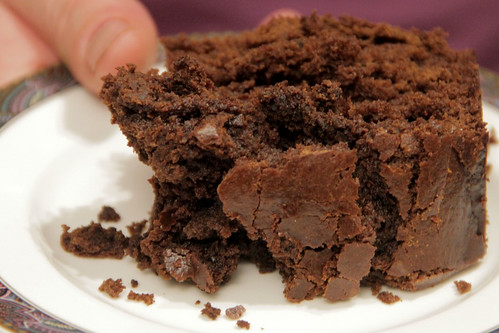
Bonbon siwo | Molasses cake | Recipe

This cake-like dessert can be pretty honestly described as a fluffy brownie, but with molasses and spices instead of chocolate. I thought it was OK, but on the dry side. (The first recipe I found called for a ridiculous four sticks of butter, whereas this one has one stick, perhaps the truth and beauty lies somewhere in between.) However, it was an excellent supporting actor for a scoop of the nutmeg ice cream left over from the Grenada meal!

Post-dinner lingering, by candlelight